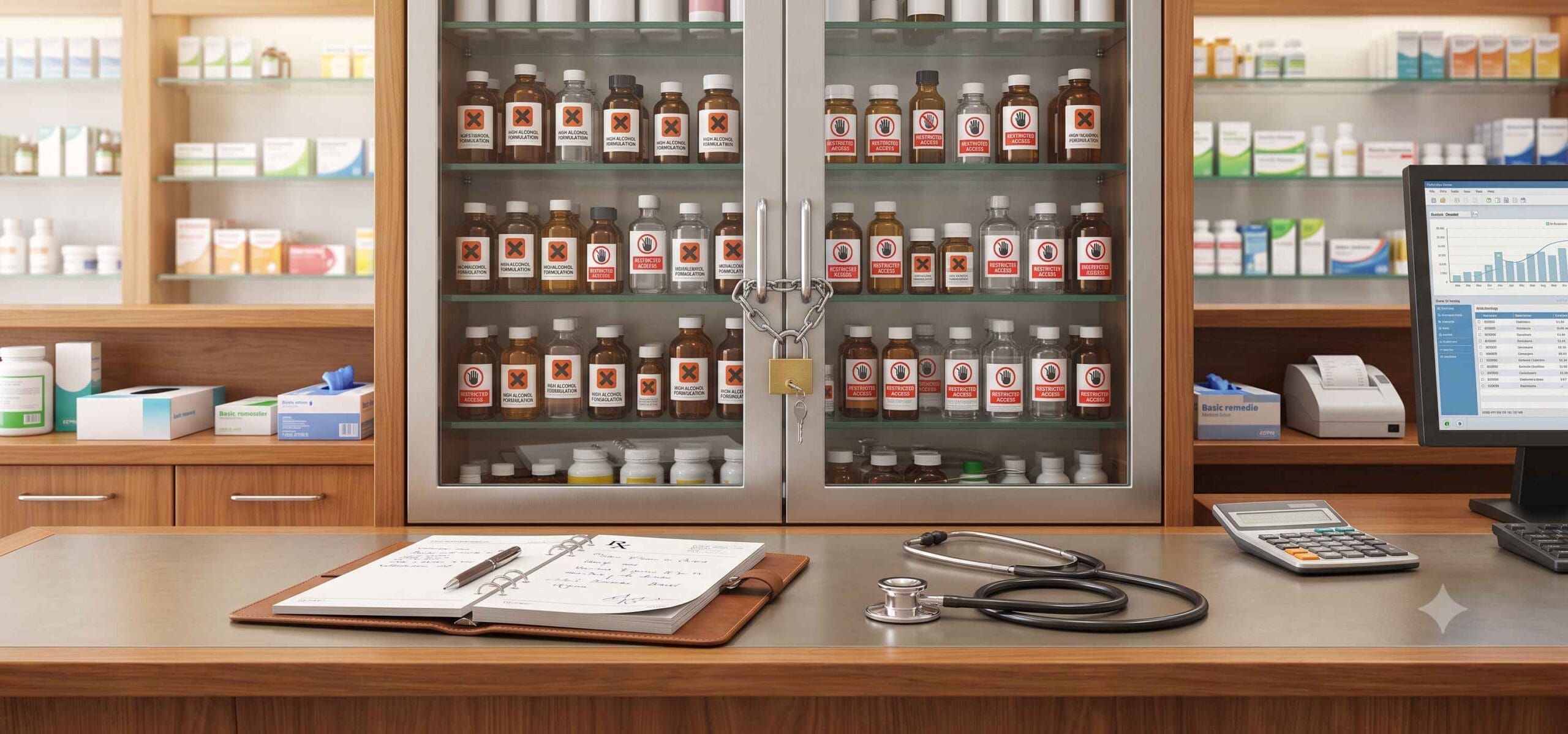
No More Over-the-Counter: India Locks Down High-Alcohol Medicines Under Strict New Prescription Rule
For decades, a small but persistent loophole in India’s drug regulations allowed certain medicinal formulations — tonics, tinctures, and aromatic preparations — to sit on pharmacy shelves without a prescription, despite containing alcohol content as high as some hard liquors. That loophole has now been closed. The Ministry of Health and Family Welfare (MoHFW) has notified the Drugs (Tenth Amendment) Rules, 2026, tightening the regulatory framework around high-alcohol medicines and bringing them firmly under Schedule H1 of the Drugs Rules, 1945.
The change means that formulations once treated as harmless household remedies will now require a doctor’s prescription, a valid drug license, and strict record-keeping — a move the government says is essential to prevent misuse for intoxication.
What Exactly Has Changed
Under the earlier framework, Schedule K of the Drugs Rules, 1945, granted certain categories of medicines — including small-scale household remedies and select institutional supplies — exemption from standard licensing requirements under the Drugs and Cosmetics Act, 1940. This exemption covered products like tinctures of cardamom, ginger, and other aromatic preparations, some of which contained ethyl alcohol concentrations of 80–90% v/v, according to the Ministry.
With the new amendment, this exemption has been withdrawn for a specific category: oral formulations containing more than 12% v/v ethyl alcohol, packed and sold in bottles or packs exceeding 30 mL. Any product meeting these two conditions — high alcohol strength and larger pack size — will no longer enjoy the Schedule K exemption and must instead be manufactured and sold under a proper license issued under the Drugs and Cosmetics Act, 1940.
Simultaneously, these formulations have been added to Schedule H1, the same category that governs high-risk drugs like certain antibiotics and habit-forming medicines. A new entry — Entry No. 52, inserted right after Pregabalin — now lists these high-alcohol oral formulations, mandating:
- Sale strictly against the prescription of a Registered Medical Practitioner (RMP)
- Stricter record-keeping by pharmacists and retailers
- Enhanced traceability to curb diversion for non-medicinal use
The notification was issued through Gazette notification G.S.R. 607(E), dated July 8, 2026, published in the Gazette of India (Extraordinary) on July 9, 2026, following consultation with the Drugs Technical Advisory Board (DTAB). The amended rules will come into force six months from the date of publication, giving manufacturers, wholesalers, and retailers time to adjust their licensing and supply chains.
Why the Government Acted Now
The trigger for this amendment was a pattern of misuse flagged by multiple State Governments. Officials found that certain “medicinal” tonics and tinctures, technically exempt from licensing because they were categorized as household remedies, were in practice being consumed for their intoxicating effect rather than any therapeutic purpose. Their high alcohol concentration, easy availability without prescription, and low cost made them an attractive substitute for regulated alcoholic beverages in several regions — particularly in areas with alcohol restrictions or high liquor taxation.
By reclassifying these formulations under Schedule H1, the government has effectively closed a regulatory gap that allowed a psychoactive substance to be sold with far less oversight than conventional alcoholic beverages or even many over-the-counter drugs.
The Ministry stated that the objective is to strengthen regulatory oversight, ensure supply only through the regulated pharmaceutical distribution chain, and reduce the possibility of diversion and misuse, while still preserving access for people who genuinely need these formulations for legitimate therapeutic use.
How This Fits a Broader Pattern
This is not an isolated move. It follows closely on the heels of another significant amendment earlier this year that made a registered medical practitioner’s prescription mandatory for cough syrups, reflecting a broader government push to tighten control over medicines with abuse or misuse potential. Just weeks before that, on June 26, 2026, the Ministry had proposed a separate set of amendments to the Drugs Rules, 1945, aimed at the opposite end of the spectrum — simplifying the procedure for obtaining permission to import drugs for examination, test, or analysis (commonly referred to as Form 11), in a bid to promote research, innovation, and ease of doing business in the pharmaceutical sector.
Together, these moves illustrate a dual regulatory strategy: tightening control where public health risk is high, such as habit-forming or misuse-prone formulations, while simplifying processes that support legitimate pharmaceutical research and innovation.
What This Means for Different Stakeholders
For patients and consumers: Formulations that were previously picked up freely from a pharmacy counter will now require a valid prescription. This may cause some short-term inconvenience for people using these products for legitimate reasons — such as certain digestive tonics or aromatic preparations — but it also protects vulnerable individuals, including minors, from easy access to a concentrated alcohol product marketed as medicine.
For manufacturers and pharmaceutical companies: Businesses producing formulations that fall under the 12% v/v ethyl alcohol and 30 mL threshold will need to secure appropriate manufacturing and sale licenses under the Drugs and Cosmetics Act, 1940, before the six-month transition window closes. Companies will also need to update packaging, labeling, and distribution protocols to comply with Schedule H1 requirements.
For pharmacists and retailers: Chemists will be required to maintain detailed prescription records for these products, similar to how they currently handle other Schedule H1 drugs, and refuse sale without a valid RMP prescription.
For public health authorities: The move gives drug control authorities and state governments a clearer legal basis to crack down on formulations being misused as an intoxicant substitute, closing a gap that had previously made enforcement difficult.
The Road Ahead
With the rules set to take effect six months after their Gazette publication, the pharmaceutical industry now has a defined window to realign its licensing, labeling, and supply chain practices. Regulatory experts suggest that state drug control departments will likely issue further implementation guidance to pharmacists and retailers as the effective date approaches, particularly around record-keeping formats and enforcement mechanisms.
For now, the amendment marks a clear signal from the Ministry of Health and Family Welfare: medicinal value does not exempt a product from scrutiny when it carries a real risk of misuse. As India continues to refine its drug regulatory architecture — tightening controls on habit-forming substances while easing pathways for genuine pharmaceutical research — this amendment adds another layer of accountability to a supply chain that touches millions of households.
Frequently Asked Questions (FAQs)
1. What is the new rule about high-alcohol medicines in India? The Ministry of Health and Family Welfare has amended the Drugs Rules, 1945, so that oral medicinal formulations containing more than 12% v/v ethyl alcohol in packs larger than 30 mL can no longer be sold without a license and now require a doctor’s prescription under Schedule H1.
2. Which products are affected by this amendment? Formulations previously exempted under Schedule K, such as certain tinctures of cardamom, ginger, and other aromatic or tonic preparations with high ethyl alcohol content (in some cases 80–90% v/v), are the primary products affected.
3. When will this rule come into effect? The Drugs (Tenth Amendment) Rules, 2026, notified via Gazette notification G.S.R. 607(E) on July 8, 2026, will come into force six months after their publication in the Official Gazette on July 9, 2026.
4. Why did the government remove the Schedule K exemption for these products? The exemption was removed because these high-alcohol formulations were being misused for intoxication due to easy over-the-counter availability, a concern raised by several State Governments to the Ministry.
5. What does inclusion under Schedule H1 mean for consumers? Schedule H1 status means these formulations can now be purchased only against a registered medical practitioner’s prescription, with pharmacists required to maintain stricter sales records, similar to other high-risk drugs in that schedule.
References
- Press Information Bureau. Government amends Drugs Rules, 1945 to strengthen regulation of high alcohol-containing drug formulations [Internet]. New Delhi: Ministry of Health and Family Welfare; 2026 Jul 10 [cited 2026 Jul 10]. Available from: https://pib.gov.in/PressReleasePage.aspx?PRID=2145678
- Raj A. Centre amends drug rules to curb misuse of high-alcohol formulations [Internet]. Business Standard. 2026 Jul 10 [cited 2026 Jul 10]. Available from: https://www.business-standard.com/health/centre-amends-drug-rules-to-curb-misuse-of-high-alcohol-formulations-126071000568_1.html
- Medical Dialogues Bureau. Health Ministry makes doctors’ prescription mandatory for high-alcohol medicines [Internet]. Medical Dialogues. 2026 Jul 10 [cited 2026 Jul 10]. Available from: https://medicaldialogues.in/news/health/health-ministry-makes-doctors-prescription-mandatory-for-high-alcohol-medicines-174734
- Outlook India. Centre tightens rules for high-alcohol oral medicines, ends OTC sales [Internet]. Outlook India. 2026 Jul 10 [cited 2026 Jul 10]. Available from: https://www.outlookindia.com/national/centre-tightens-rules-for-high-alcohol-oral-medicines-ends-otc-sales
- The Tribune. High-alcohol medicinal formulations to require licence, prescription [Internet]. The Tribune. 2026 Jul 10 [cited 2026 Jul 10]. Available from: https://www.tribuneindia.com/news/india/high-alcohol-medicinal-formulations-to-require-licence-prescription/