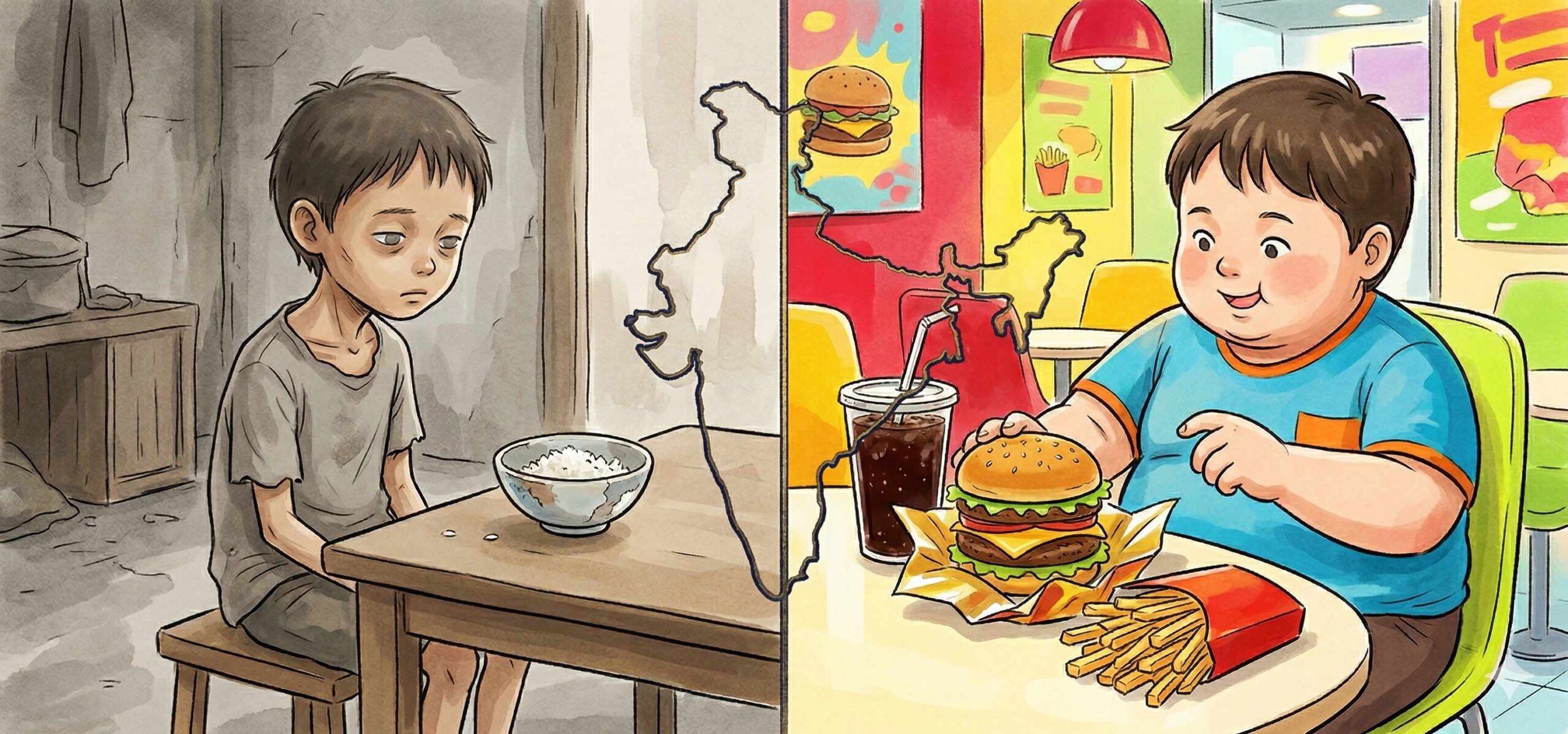
India today faces a striking paradox—the coexistence of obesity and malnutrition within the same population, often within the same household. This “double burden of malnutrition” reflects rapid socio-economic and dietary transitions.
On one side, undernutrition remains a major concern. According to the National Family Health Survey (NFHS-5, 2019–21), about 35–36% of children under five are stunted, 19% are wasted, and 32% are underweight . These figures indicate chronic and acute nutritional deprivation. Additionally, over 50% of women are anaemic, highlighting widespread micronutrient deficiencies . These problems persist due to poverty, food insecurity, poor maternal nutrition, infections, and inadequate sanitation.At the same time, overnutrition is rapidly increasing. NFHS-5 data shows that about 24% of women and 23% of men in India are overweight or obese, with 6.4% of women and 4% of men classified as obese . Alarmingly, obesity is rising even among children—overweight prevalence in under-five children increased from 2.1% to 3.4% between NFHS-4 and NFHS-5 , and has more than doubled over the past decade .
The coexistence of these extremes is driven by several factors. First is the nutrition transition, where traditional diets rich in fiber are replaced by processed, calorie-dense foods. While caloric intake may increase, nutrient quality often declines, leading to “hidden hunger.” Second, economic and social inequality plays a crucial role. Even within the same household, food distribution can be unequal, with women and children often receiving less nutritious food. Meanwhile, urban populations with higher incomes may consume excess calories but poor-quality diets. Third, urbanization and lifestyle changes contribute significantly. Sedentary behavior, increased screen time, and easy access to fast food promote obesity. At the same time, rural and marginalized populations continue to struggle with basic nutrition and healthcare access. Another important explanation is the life-course effect. Children who experience undernutrition early in life are more likely to develop obesity and non-communicable diseases later due to metabolic adaptations, often referred to as the “thrifty phenotype.”
Thus, India’s problem is not simply lack or excess of food—it is imbalance. While progress has been made in reducing undernutrition, the simultaneous rise in obesity shows that the country is undergoing an uneven and complex health transition. In conclusion, India’s double burden of malnutrition reflects deep-rooted socio-economic disparities, dietary shifts, and lifestyle changes. Addressing it requires integrated strategies that improve food quality, strengthen public health programs, and promote healthy behaviors across all sections of society.
References:
- International Institute for Population Sciences (IIPS), ICF. National Family Health Survey (NFHS-5), 2019–21: India Report. Mumbai: IIPS; 2021. Available from: https://rchiips.org/nfhs/NFHS-5Reports/India.pdf
- Government of India. Press Information Bureau. National Family Health Survey-5 (NFHS-5) findings released [Internet]. New Delhi: Ministry of Health and Family Welfare; 2021 [cited 2026 Apr 11]. Available from: https://pib.gov.in/PressReleasePage.aspx?PRID=1785655
- UNICEF India. Overweight and obesity rising across all ages in India [Internet]. New Delhi: UNICEF; 2023 [cited 2026 Apr 11]. Available from: https://www.unicef.org/india/press-releases/india-overweight-and-obesity-rising-across-all-ages-youngest-children-adults
- Barry M. Popkin. The nutrition transition and obesity in the developing world. J Nutr. 2001;131(3):871S–873S. Available from: https://www.ncbi.nlm.nih.gov/pmc/articles/PMC3257829/
- World Health Organization. Malnutrition: double burden of malnutrition [Internet]. Geneva: WHO; [cited 2026 Apr 11]. Available from: https://www.who.int/news-room/fact-sheets/detail/malnutrition