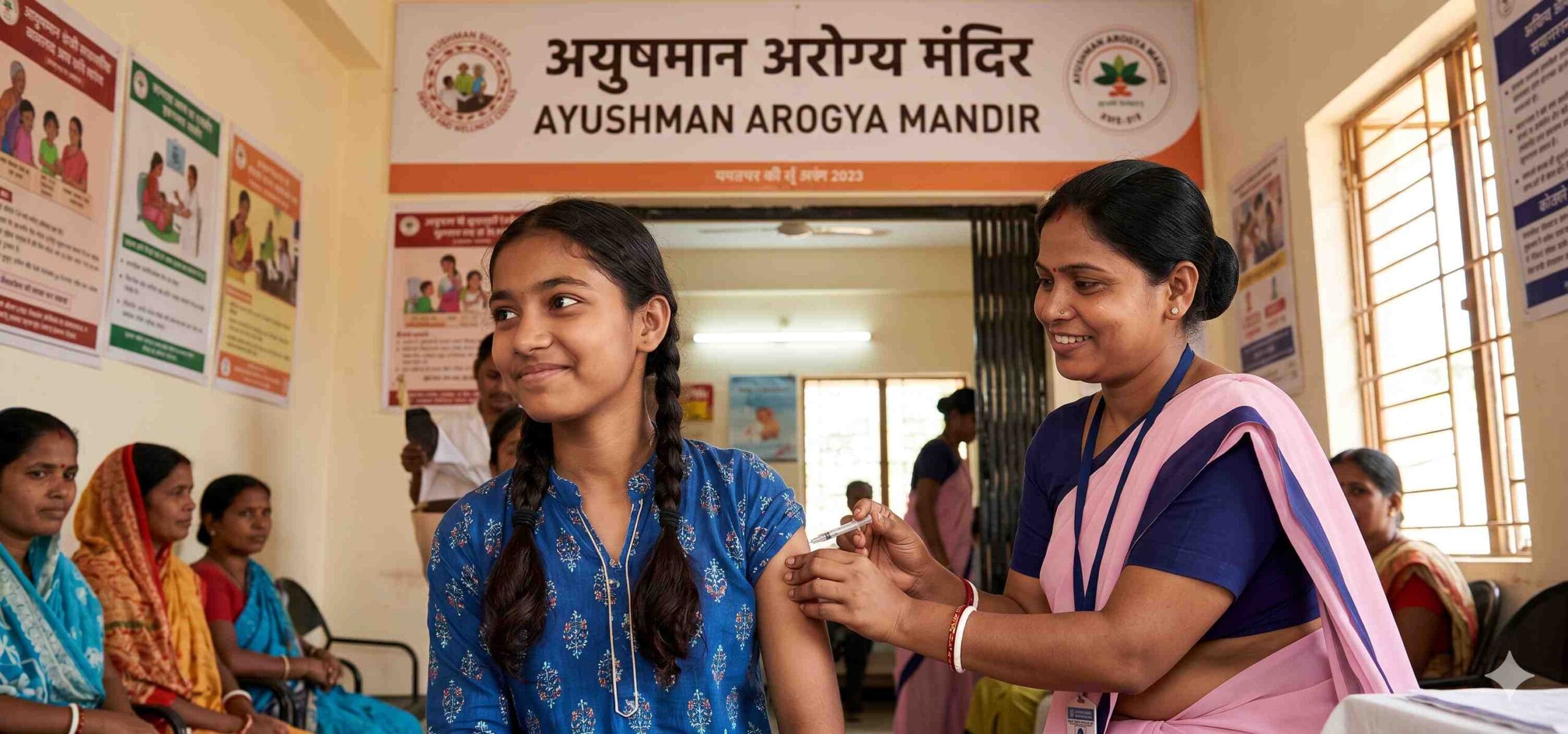
On February 28, 2026, Prime Minister Narendra Modi stood in Ajmer, Rajasthan, and did something that could quietly save hundreds of thousands of lives over the coming decades. He launched India’s nationwide Human Papillomavirus (HPV) Vaccination Programme — making India the 161st country in the world to include the HPV vaccine in its national immunisation schedule, and the first to offer it free of cost at this scale to girls across every state and Union Territory.
It was a moment that public health professionals had been calling for years. And for the 1.15 crore (approximately 11.5 million) fourteen-year-old girls now eligible to receive the vaccine at no cost, it represents something far more personal: a chance to prevent a cancer before it ever begins.
What Is the HPV Vaccine, and Why Does It Matter for India?
Cervical cancer is, at its core, a preventable disease. It is caused almost entirely by persistent infection with Human Papillomavirus (HPV) — a common sexually transmitted infection for which a highly effective vaccine has existed since 2006. Yet for decades, India carried a disproportionately heavy burden of this disease.
India accounts for roughly one-fifth of all cervical cancer cases in the world, with approximately 1,23,000 new diagnoses reported every year. More starkly, nearly 75,000 Indian women die from the disease annually — that is one in every four cervical cancer deaths globally. HPV types 16 and 18 are responsible for more than 80% of cervical cancer cases in India, making a vaccine that targets these strains an extraordinarily powerful public health tool.
Despite this reality, vaccination rates for HPV in India’s target age group were close to zero before 2022. Screening coverage remained under 5%. The disease continued to claim lives that could have been saved. India’s 2026 national programme is a direct and decisive response to this long-standing gap.
What Was Launched on February 28, 2026?
The launch was not a soft rollout. On the same day that PM Modi initiated the national campaign in Ajmer, states and Union Territories across the country simultaneously held their own launch events, signalling the scale of political and administrative commitment behind this initiative.
Under the programme, all girls aged 14 years across India are eligible to receive a single dose of the Gardasil-4 (quadrivalent HPV vaccine) free of cost at designated government health facilities. These include Ayushman Arogya Mandirs, community health centres, district hospitals, and medical colleges.
To maximise reach in the opening phase, a 90-day intensive vaccination drive was launched immediately, with vaccinations available daily at all designated sites. Girls turning 15 within 90 days of the launch date are also eligible. After the campaign period, the vaccine will continue to be available on routine immunisation days under the Universal Immunisation Programme (UIP).
The programme fulfils a commitment made in the Union Budget 2024 and aligns directly with the World Health Organization’s global target to eliminate cervical cancer as a public health threat by 2030.
Which Vaccine Is Being Used, and Is It Safe?
India’s national programme uses Gardasil-4, a quadrivalent HPV vaccine manufactured by Merck. The vaccine targets four HPV types:
- Types 16 and 18 — responsible for more than 80% of cervical cancers in India
- Types 6 and 11 — responsible for genital warts
A single dose of Gardasil-4 provides 93–100% effectiveness against the HPV types responsible for cervical cancer. This high efficacy with just one dose is supported by WHO recommendations for single-dose schedules in adolescent girls, and reflects emerging evidence of long-term immunity from a single immunisation in this age group.
Gardasil is one of six WHO-prequalified HPV vaccines globally, and is approved by India’s Central Drugs Standard Control Organisation (CDSCO). The vaccine supply is being procured through a transparent mechanism in partnership with GAVI, the Vaccine Alliance, with over one crore doses secured to ensure uninterrupted supply and cold-chain quality.
As for safety — HPV vaccines have one of the most robust safety records in modern immunology. More than 500 million doses have been administered worldwide since 2006. Side effects are typically mild and short-lived, including soreness at the injection site, mild fever, or temporary dizziness. Each vaccination site under the national programme is equipped with a Cold Chain Point (CCP) and a dedicated medical officer to monitor and manage any adverse events following immunisation (AEFI).
Vaccination is entirely voluntary. Informed written consent from parents or guardians is obtained before administration.
Why Age 14? The Science Behind the Target Group
The choice of 14 as the primary target age is deliberate and evidence-based. The HPV vaccine works best when administered before any possible exposure to the virus. The immune response generated in pre-adolescent and adolescent girls is significantly stronger than that generated later in life, meaning that a single dose at this age confers protection that would require multiple doses in older individuals.
Over a three-year catch-up phase, the government plans to vaccinate approximately 1.15 crore girls annually, equating to nearly 2.6 crore doses by 2027 — a logistical undertaking of enormous scale. Pilot phases in Uttar Pradesh, Bihar, and Maharashtra preceded the national expansion, providing the operational blueprint for this rollout under the UIP.
What Does This Mean for the Burden of Cervical Cancer in India?
The numbers speak for themselves. Cervical cancer kills nearly 80,000 Indian women every year — many of them in their most productive years, often the primary caregivers and earners of their families. The disease results in the loss of 1.37 million Disability Adjusted Life Years (DALYs), a staggering toll on individuals, families, and the healthcare system.
Global experience from countries that introduced HPV vaccination early is unequivocal: sharp declines in HPV infections, precancerous lesions, and eventually cervical cancer cases follow within years of high-coverage vaccination programmes. The UK, Australia, and several Scandinavian countries have already reported dramatic reductions in HPV-related disease among vaccinated cohorts.
For India, the impact is expected to be not just national but global. Experts at GAVI have said that India’s introduction of HPV vaccination for more than 10 million girls per year will have a profound impact on worldwide cervical cancer statistics, given the country’s current share of global cases.
What About India’s Own Domestic Vaccine — Cervavac?
India is not solely dependent on imported supplies. The Serum Institute of India has developed Cervavac, a quadrivalent HPV vaccine that has been found non-inferior to existing vaccines when administered in two doses. Cervavac is currently seeking WHO prequalification, and the Indian Council of Medical Research launched a study in November 2024 among 500 girls aged 9–14 to assess single-dose immune responses.
If Cervavac achieves WHO prequalification and demonstrates comparable single-dose efficacy, it could become a key domestic supply option — reducing dependence on imported vaccines, lowering costs further, and positioning India as a manufacturer of HPV vaccines for the global market.
The Bigger Picture: Swastha Nari and Global Elimination Goals
India’s free HPV vaccination programme is anchored in the government’s “Swastha Nari” vision — ensuring that prevention, protection, and equity form the foundation of women’s healthcare across the country.
The programme also represents a turning point in how India approaches preventive oncology. For too long, the country’s healthcare infrastructure has been weighted toward treatment rather than prevention. A free, universally accessible vaccine against a cancer-causing virus is perhaps the most powerful expression of the prevention-first philosophy in public health.
With this launch, India joins over 160 countries that have introduced HPV vaccination into their national immunisation schedules — a global coalition working toward the WHO’s 2030 elimination target. For India to make this commitment at scale, covering one of the world’s largest adolescent female populations, is a moment that deserves recognition not just domestically but internationally.
What Should Parents and Guardians Do Now?
If you are the parent or guardian of a 14-year-old girl, here is what you need to know:
- The vaccine is completely free at all government health facilities.
- Your daughter needs just one dose under the current national programme.
- Vaccination is voluntary — written consent will be requested.
- The 90-day intensive campaign runs daily; visit your nearest Ayushman Arogya Mandir, Community Health Centre, or district hospital.
- Girls turning 15 within 90 days of February 28, 2026, are also eligible during the campaign phase.
- After the campaign period, the vaccine remains available on routine immunisation days.
Key Takeaways
- India’s free HPV vaccination programme was launched on February 28, 2026, targeting 1.15 crore girls aged 14 annually.
- A single dose of Gardasil-4 offers 93–100% effectiveness against the HPV types causing most cervical cancers in India.
- Cervical cancer kills approximately 75,000–80,000 Indian women every year; India accounts for one-fourth of global deaths from this disease.
- Vaccine supply is secured through GAVI, the Vaccine Alliance; the Serum Institute’s Cervavac is pending WHO prequalification.
- India now joins over 160 countries with HPV vaccination in their national immunisation programmes.
- The initiative aligns with WHO’s goal to eliminate cervical cancer as a public health threat by 2030.
References
- Press Information Bureau, Government of India. Cervical cancer vaccination campaign launched. PIB Delhi. 2026 Feb 28 [cited 2026 May 25]. Available from: https://www.pib.gov.in/PressReleasePage.aspx?PRID=2234009®=3&lang=2
- GAVI, the Vaccine Alliance. India, home to 25% of the world’s cervical cancer deaths, launches nationwide HPV vaccination. 2026 Mar 16 [cited 2026 May 25]. Available from: https://www.gavi.org/vaccineswork/india-home-25-worlds-cervical-cancer-victims-launches-nationwide-hpv-vaccination
- World Health Organization. Human papillomavirus vaccines: WHO position paper, 2022. Wkly Epidemiol Rec. 2022;97(50):645–72 [cited 2026 May 25]. Available from: https://www.who.int/publications/i/item/who-wer9750
- News on AIR, All India Radio. PM Modi to launch nationwide HPV vaccination programme for 14-year-old girls from Ajmer. 2026 Feb 27 [cited 2026 May 25]. Available from: https://www.newsonair.gov.in/pm-modi-to-launch-nationwide-hpv-vaccination-programme-for-14-year-old-girls-from-ajmer-tomorrow
- Organiser. HPV vaccination: India’s mission to end cervical cancer. 2026 Feb 25 [cited 2026 May 25]. Available from: https://organiser.org/2026/02/25/341642/bharat/how-indias-free-hpv-vaccination-programme-aims-to-eliminate-cervical-cancer-among-young-girls/