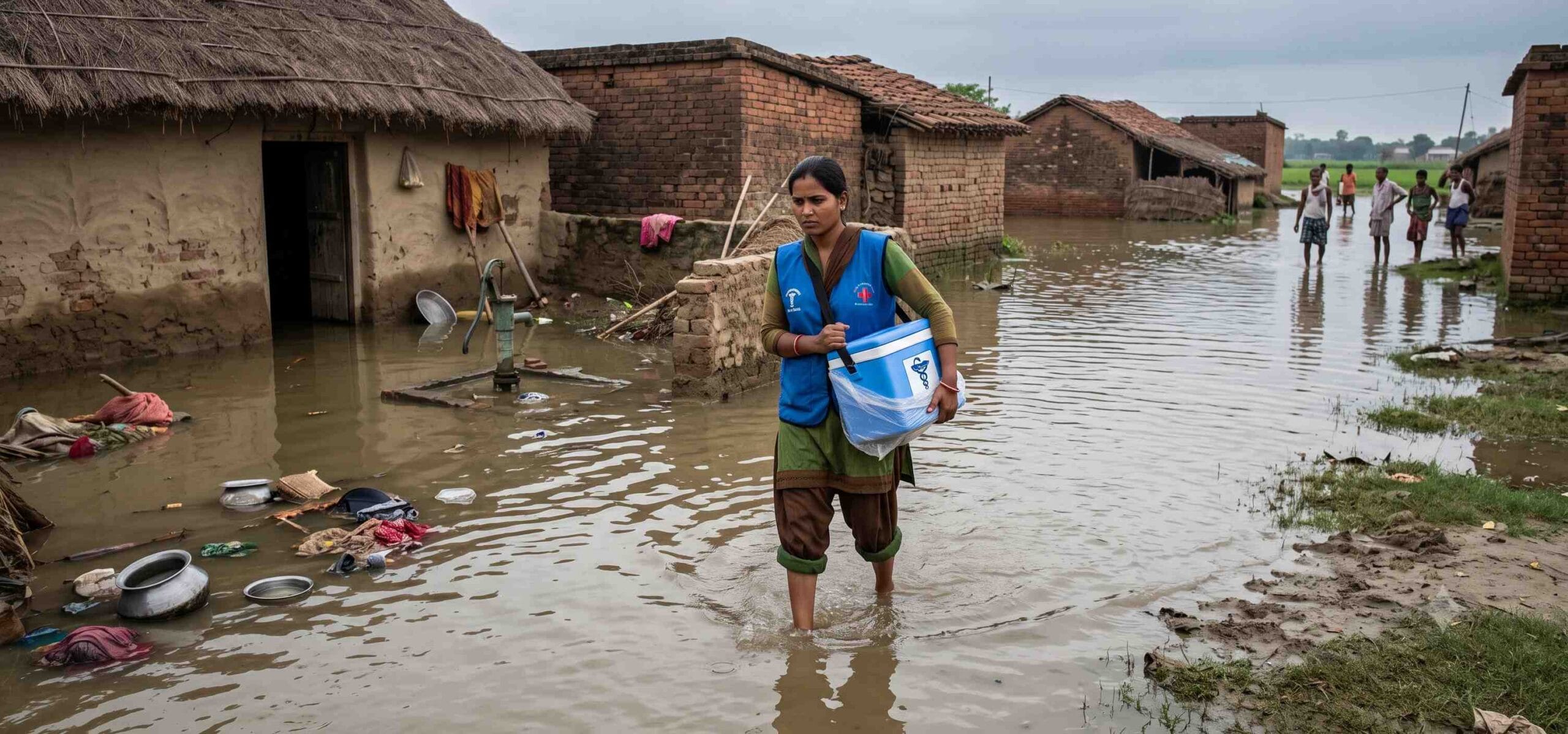
Beyond Floods: Why India’s Monsoon Preparedness Must Also Mean Snakebite Readiness
Every year, as the southwest monsoon sweeps across India between June and September, disaster management machinery swings into action — flood alerts, evacuation drills, relief camps, and emergency shelters. Yet one recurring monsoon casualty rarely features in this planning: snakebite deaths. As floodwaters submerge burrows and displace snakes into paddy fields, homes, and relief shelters, India quietly faces one of its deadliest and most overlooked public health emergencies — one that unfolds almost entirely out of the media spotlight and largely in rural, tribal, and agricultural communities.
The Scale of the Crisis
India carries the heaviest global burden of snakebite deaths. Government estimates put the annual death toll at around 50,000–58,000, accounting for nearly half of all snakebite fatalities worldwide. A landmark study covering the period 2000–2019 estimated that more than 1.2 million Indians died from snakebites over those two decades — an average of 58,000 deaths every year, alongside roughly 140,000 additional disabilities annually. Nearly 28% of these deaths occurred in children under 15, whose smaller body mass makes envenoming faster and more severe.
Almost 94% of snakebite deaths occur in rural India, where the reality of flood season compounds an already fragile healthcare access problem. The lifetime risk of dying from a snakebite before age 70 has been estimated at roughly 1 in 250 nationally — and as high as 1 in 100 in the worst-affected regions, including parts of central and eastern India.
Why Monsoon Floods Are a Snakebite Multiplier
Snakebite risk does not rise randomly during the monsoon — it follows a predictable ecological pattern. Heavy rain floods snake burrows and natural habitats, forcing snakes out into the open in search of dry ground. At the same time, floodwaters displace rodents and frogs — the primary prey for many venomous species — closer to human dwellings, and snakes follow their food source. Cooler, waterlogged ground also pushes cold-blooded snakes toward warmer, drier spaces such as homes, granaries, and relief shelters, increasing the odds of an accidental encounter.
This is also peak breeding season for many snake species, meaning both adult snakes and juveniles are more active and more likely to be encountered by agricultural workers, children playing outdoors, and families sleeping on the floor in flood-affected homes. The overlap of flood displacement, agricultural activity, and snake breeding season creates what public health experts describe as a “compound hazard” — one where a single climatic event triggers two simultaneous health emergencies.
The “Big Four” and India’s Antivenom Gap
Most severe envenoming in India is attributed to the so-called “Big Four” venomous species: the Indian cobra, common krait, Russell’s viper, and the saw-scaled viper. India’s polyvalent antivenom is manufactured specifically to counter venom from these species, produced by injecting small doses of venom into horses and harvesting the resulting antibodies.
However, this “Big Four” antivenom does not cover dozens of other medically significant snake species found across India’s diverse terrain — including regional pit vipers found in the Himalayan states and the Western Ghats. Experts have repeatedly flagged the need for region-specific antivenom, given that a single national formulation cannot account for venom variation across India’s ecological zones. During flood emergencies, this gap becomes even more dangerous: supply chains to remote health centres are disrupted precisely when bite incidence spikes.
A Crisis Hidden by Underreporting
Compounding the treatment gap is a severe underreporting problem. In many tribal and rural pockets, snakebite victims first approach faith healers rather than hospitals, delaying medical intervention until envenoming symptoms — paralysis, internal bleeding, kidney failure — become critical. Cultural beliefs that frame snakebite as a curse rather than a medical emergency continue to steer victims away from timely antivenom treatment, especially in flood-hit areas where road access to hospitals may already be cut off.
Because many bites are treated informally or the victim dies before reaching a health facility, official statistics likely undercount the true toll. The Union Ministry of Health and Family Welfare has directed all states to classify snakebite as a notifiable disease, compelling healthcare workers to report every case. States including Tamil Nadu, Karnataka, and Odisha have implemented this order, improving surveillance and data quality. Other states, however, continue to lag, leaving significant gaps in the national picture of who is dying and where.
India’s Policy Response: NAPSE
In recognition of the scale of the problem, India launched the National Action Plan for Prevention and Control of Snakebite Envenoming (NAPSE) in 2024, setting an ambitious target of halving snakebite deaths by 2030, in line with World Health Organization goals. NAPSE’s framework rests on several pillars:
- Strengthening surveillance systems and mandatory case reporting
- Improving anti-snake venom (ASV) distribution and quality, including regional formulations
- Enhancing healthcare infrastructure and training frontline health workers in snakebite management
- Establishing Regional Venom Centres and Poison Information Centres
- Running community awareness campaigns, particularly in tribal and rural belts
- Improving emergency referral and transport systems to get victims to treatment faster
Experts broadly welcome NAPSE as a step in the right direction, but implementation on the ground remains inconsistent. Persistent challenges include inadequate training among primary healthcare staff, unreliable antivenom stocks in remote areas, poor ambulance and referral networks, and continued reliance on traditional healers over hospitals.
Why Flood Preparedness Must Include Snakebite Readiness
Disaster management frameworks in India — built primarily around evacuation, shelter, and waterborne disease control — rarely integrate snakebite risk as a core planning consideration, despite the clear seasonal correlation. Public health specialists argue that this must change, with monsoon preparedness plans explicitly incorporating:
- Pre-positioning antivenom stocks at flood-prone district hospitals and primary health centres before the monsoon peaks
- Training relief camp staff to recognise envenoming symptoms and administer first aid correctly
- Rapid transport protocols for snakebite victims in areas where roads are flooded or cut off
- Community-level awareness on avoiding tall grass, standing water, and debris piles, and on sealing entry points in homes and temporary shelters
- Coordinated data-sharing between disaster management authorities and health departments to flag high-risk zones in real time
Countries facing similar monsoon-driven snakebite spikes, from Pakistan to parts of Southeast Asia, have scaled up antivenom stockpiles and issued public advisories during flood emergencies — a model India’s state disaster management authorities could adopt more systematically.
The Bottom Line
Snakebite is often described as a “disease of the poor” — a crisis that disproportionately affects farmers, tribal communities, and children in India’s most underserved rural regions, and one that rarely commands the same policy urgency as visible disasters like floods or cyclones. Yet the two are deeply intertwined: the very floodwaters that damage homes and displace families also drive snakes into direct contact with people. As climate change makes monsoon rainfall more erratic and extreme weather events more frequent, experts warn that snakebite risk is likely to rise in tandem.
Treating snakebite readiness as a routine part of India’s monsoon and flood-response planning — not an afterthought — could meaningfully reduce a death toll that has remained stubbornly high for decades. Awareness campaigns alone, however well-intentioned, cannot substitute for reliable antivenom supply chains, trained healthcare workers, and functioning referral systems reaching the last mile.
Frequently Asked Questions (FAQs)
1. Why do snakebites increase during India’s monsoon season? Heavy monsoon rain floods snake burrows and natural habitats, forcing snakes into the open in search of dry ground. Flooding also displaces rodents and frogs that snakes prey on, drawing snakes closer to homes, fields, and relief shelters where people are present.
2. How many people die from snakebites in India each year? Government and independent estimates suggest around 50,000 to 58,000 people die from snakebites in India annually, accounting for nearly half of all snakebite deaths worldwide, with the majority occurring in rural areas during the monsoon season.
3. Which snake species cause the most snakebite deaths in India? Most severe envenoming cases are attributed to the “Big Four”: the Indian cobra, common krait, Russell’s viper, and the saw-scaled viper. India’s standard polyvalent antivenom is designed specifically to treat bites from these four species.
4. What is India doing to reduce snakebite deaths? India launched the National Action Plan for Prevention and Control of Snakebite Envenoming (NAPSE) in 2024, aiming to halve snakebite deaths by 2030 through better surveillance, improved antivenom access, stronger healthcare infrastructure, and community awareness programs.
5. Why is snakebite considered an overlooked health crisis in India? Despite its high death toll, snakebite predominantly affects poor, rural, and tribal communities with limited political visibility. Underreporting, reliance on faith healers instead of hospitals, and inconsistent state-level policy adoption keep it out of mainstream disaster-planning priorities.
References
- Down To Earth. Jharkhand: Why have snakebite deaths spiked in the state of late? [Internet]. New Delhi: Down To Earth; 2025 Jul 28 [cited 2026 Jul 11]. Available from: https://www.downtoearth.org.in/health/jharkhand-why-have-snakebite-deaths-spiked-in-the-state-of-late
- Ray-Bennett NS, Caley T, Samuel SP. Right anti-venom, given on time, can reduce snakebite deaths in India [Internet]. Down To Earth; 2024 Apr 25 [cited 2026 Jul 11]. Available from: https://www.downtoearth.org.in/health/right-anti-venom-given-on-time-can-reduce-snakebite-deaths-in-india-88507
- The Guardian. India’s snakebite crisis is killing tens of thousands every year [Internet]. 2026 Feb 5 [cited 2026 Jul 11]. Available from: https://ippmedia.com/the-guardian/features/read/indias-snakebite-crisis-is-killing-tens-of-thousands-every-year-2026-02-05-105906
- The Globe and Mail. India aims to combat deadly snake bites in a country where some believe “it is a curse, not a medical emergency” [Internet]. 2025 Aug 4 [cited 2026 Jul 11]. Available from: https://www.theglobeandmail.com/world/article-india-snakebite-program-death-prevention-anti-venom/
- National Action Plan for Prevention and Control of Snakebite Envenoming (NAPSE) in India: challenges, lessons learnt and way forward for stakeholders’ participatory approach [Internet]. PMC; [cited 2026 Jul 11]. Available from: https://pmc.ncbi.nlm.nih.gov/articles/PMC12115389/