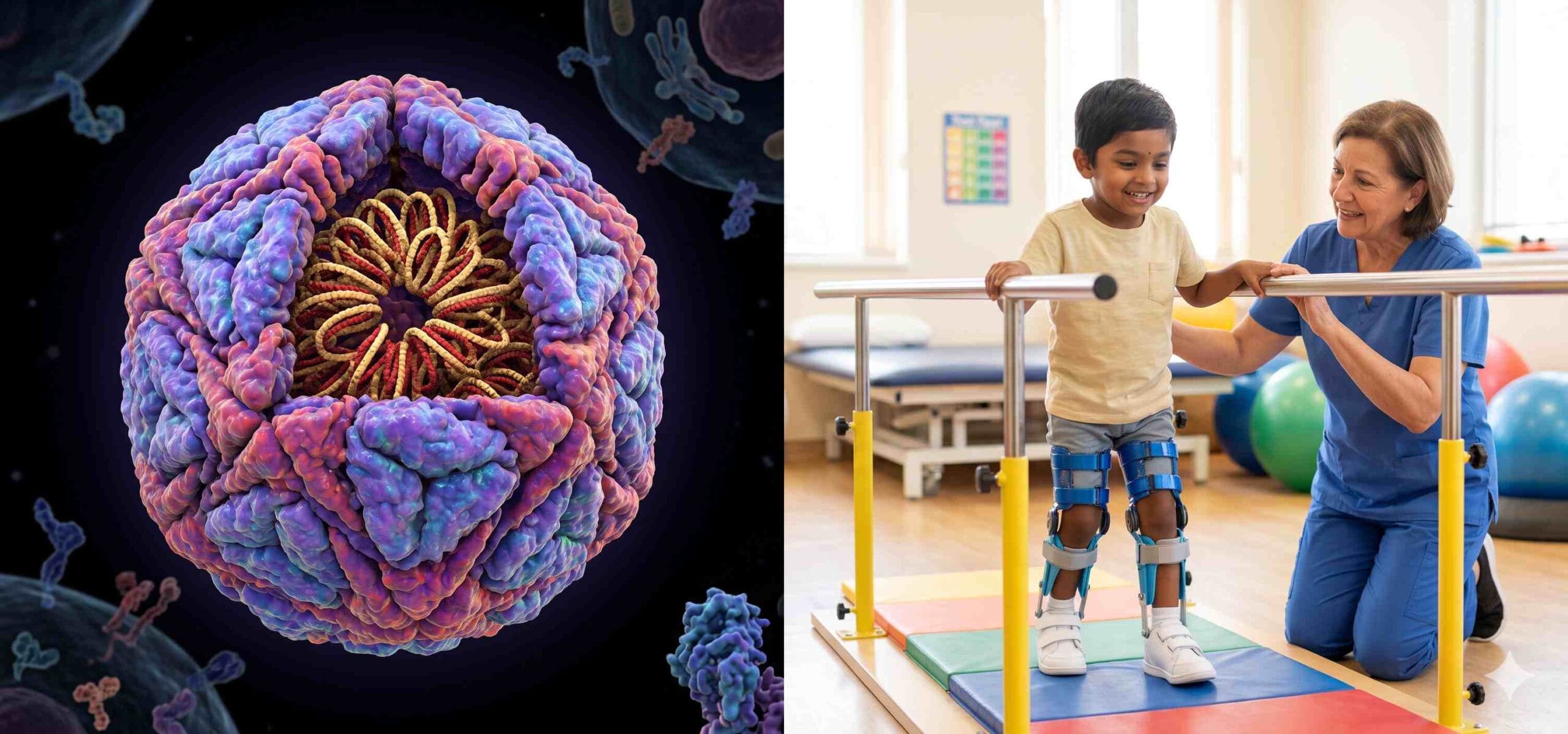
In 1988, poliovirus paralysed an estimated 350,000 children across 125 countries. By 2026, that number has been reduced by more than 99.9% — one of the most extraordinary achievements in the history of public health. And yet, in the mountainous districts of Kunar and the southern plains of Helmand in Afghanistan, children are still losing the use of their limbs to this ancient, entirely preventable disease. Six confirmed cases of Wild Poliovirus Type 1 (WPV1) in Afghanistan in 2026 alone. Nine globally.
That is not a victory. It is a warning. As long as poliovirus circulates anywhere, it threatens children everywhere. Understanding what poliovirus is — its biology, its behaviour, how it causes paralysis, how it spreads, and why it has resisted eradication for so long — is not just academic. In a world still trying to finish the job, it is essential knowledge.
What Is Poliovirus?
Poliovirus is a member of the genus Enterovirus, belonging to the family Picornaviridae — small, non-enveloped RNA viruses that are highly stable in the environment and resistant to acidic conditions, making them exceptionally well-suited to the faecal-oral route of transmission. It is one of the most contagious pathogens known to science and, in its paralytic form, one of the most feared.
There are three distinct serotypes of poliovirus: type 1, type 2, and type 3. All three can cause paralysis, but type 1 has historically been the most paralytogenic — the most frequently associated with epidemic spread and irreversible limb weakness. Type 2 was certified globally eradicated in 2015; type 3 followed in 2019. Only Wild Poliovirus Type 1 (WPV1) remains in natural circulation, endemic solely in Afghanistan and Pakistan — the last two countries in the world where the virus has never been completely interrupted.
Humans are the only natural host of poliovirus. There is no animal reservoir. This is biologically significant: it means eradication is theoretically achievable. If every human on earth were immune, the virus would have nowhere to go and would cease to exist in nature. The challenge, as Afghanistan in 2026 demonstrates with painful clarity, is reaching that state of universal immunity — particularly in populations defined by conflict, displacement, and inaccessibility.
How Does Poliovirus Spread?
Poliovirus spreads primarily through the faecal-oral route — by consuming water or food contaminated with the faeces of an infected person. In settings with poor sanitation and inadequate access to clean water, this is an efficient and relentless pathway of transmission. The virus can survive for weeks in water and sewage, and a single infected individual can silently seed an entire community.
A secondary route of transmission — less commonly documented but epidemiologically relevant — is through respiratory droplets, particularly oropharyngeal secretions. Once infected, individuals can shed the virus in their faeces for several weeks, including during the period before any symptoms appear. This silent shedding is what makes poliovirus so difficult to contain: by the time a child develops paralysis, the virus has almost certainly already spread to dozens of others.
Environmental surveillance — the systematic testing of sewage and wastewater samples for poliovirus — has become an indispensable tool for tracking the virus precisely because clinical cases represent only a tiny fraction of total infections. In Afghanistan and Pakistan, positive environmental samples consistently outpace clinical paralysis cases by a ratio of many hundreds to one. The most recent WPV1-positive environmental sample from Afghanistan was collected on April 27, 2026, even as only six paralytic cases had been confirmed by that date.
What Happens When Poliovirus Infects the Body?
The clinical spectrum of poliovirus infection is wide — and this variability is one of the reasons the virus is so epidemiologically dangerous.
Approximately 70% of infections are entirely asymptomatic. The infected individual never knows they are carrying and transmitting the virus.
Approximately 25% develop abortive poliomyelitis — a mild, non-specific illness characterised by low-grade fever, headache, sore throat, nausea, vomiting, and abdominal pain. This phase is virtually indistinguishable from dozens of other viral illnesses and resolves without medical intervention within a few days.
Between 1% and 5% of infected individuals develop non-paralytic poliomyelitis — also called aseptic meningitis — presenting with stiffness of the neck and back, headache, and sometimes altered sensation. This too is typically self-limiting.
Fewer than 1% of infections progress to the most feared outcome: paralytic poliomyelitis. In this form, the virus crosses the blood-brain barrier and invades the anterior horn motor neurons of the spinal cord — the cells responsible for initiating voluntary muscle movement. When these neurons are destroyed, the muscles they control become flaccid and atrophied. The resulting paralysis is typically asymmetric — affecting one limb more than others — proximal — more severe in the hip and thigh than the foot — and, in the majority of cases, permanent.
The incubation period for non-paralytic symptoms is three to six days. For paralysis, it is typically 7 to 21 days from infection, though the neurological phase can begin as early as four days or as late as five weeks after exposure. Paralysis usually develops rapidly — reaching its maximum severity within 48 hours — and does not progress further once the fever subsides. There is no reversal. There is no cure.
In its most severe form — bulbar poliomyelitis — the brainstem is affected, compromising the cranial nerve nuclei that control swallowing, speech, and breathing. This form carries a case fatality rate of up to 25% and may require long-term ventilatory support.
Diagnosing Poliovirus
A probable case of polio is defined clinically as the acute onset of flaccid paralysis in one or more limbs, with absent or reduced tendon reflexes, without sensory or cognitive loss, and without another apparent cause. In any child under 15 presenting with acute flaccid paralysis (AFP), poliovirus must be included in the differential diagnosis and laboratory testing initiated urgently.
Laboratory confirmation requires:
- Stool specimens — the gold standard, as the virus is shed in high concentrations in faeces during the early stage of illness. Two samples are collected 24–48 hours apart, ideally within 14 days of paralysis onset.
- Viral isolation from stool, cerebrospinal fluid (CSF), or nasopharyngeal swabs in cell culture — the definitive confirmatory method.
- Polymerase chain reaction (PCR) and genomic sequencing — increasingly used to confirm poliovirus and to determine whether the isolate is wild-type (WPV) or vaccine-derived (cVDPV), and to trace transmission chains.
Differential diagnoses that must be considered alongside poliovirus include Guillain-Barré syndrome, transverse myelitis, and enterovirus D68-associated AFP.
Treatment: There Is None — Only Support and Prevention
There is no specific antiviral treatment for poliovirus infection. Management is entirely supportive — aimed at keeping the patient comfortable, managing pain, preventing respiratory failure in bulbar cases, and minimising the secondary complications of immobility (pressure sores, contractures, urinary tract infections).
For children who survive paralytic poliomyelitis, the road ahead involves long-term rehabilitation: physiotherapy to maximise residual muscle function; orthotics and assistive devices to support mobility; and psychological support to address the profound social and economic consequences of permanent disability in environments where healthcare infrastructure is already severely under-resourced.
There is one additional, late-onset complication that must not be overlooked: Post-Polio Syndrome (PPS). Decades after the acute infection — often 30 to 40 years later — survivors can experience new or worsening weakness, fatigue, muscle pain, and breathing difficulties. PPS is believed to result from the progressive degeneration of motor neurons that were damaged but not destroyed during the original infection. It affects an estimated 25–40% of polio survivors globally, adding a long tail of suffering to an already devastating disease.
Vaccines: The Only Weapon That Works
Prevention through vaccination is the only meaningful tool against poliovirus. Two vaccines are in global use:
Oral Polio Vaccine (OPV) contains live-attenuated (weakened) poliovirus and is administered as drops into the mouth. It is inexpensive, easily administered without needles, induces strong intestinal immunity that interrupts faecal-oral transmission, and is the primary tool of mass vaccination campaigns. The current formulation deployed in campaigns in Afghanistan and Pakistan is bivalent OPV (bOPV), targeting types 1 and 3.
Inactivated Polio Vaccine (IPV) contains killed poliovirus and is administered by injection. It generates excellent immunity in the bloodstream, protecting the individual from paralysis, and is the standard used in routine immunisation schedules in most countries, including India. It does not, however, induce the same level of intestinal immunity as OPV and therefore does not as effectively block person-to-person transmission.
Both vaccines are highly effective. Multiple doses are required to achieve full protection, particularly in areas with high infection pressure and poor sanitation. In Afghanistan, children have received as many as 16 or more doses of oral polio vaccine before being stricken — a stark demonstration that no single dose, and no campaign in isolation, is sufficient when the virus is actively circulating in a population with significant immunity gaps.
In February 2026, WHO prequalified an additional novel oral polio vaccine type 2 (nOPV2), strengthening the toolkit for responding to outbreaks of circulating vaccine-derived poliovirus — a separate but related challenge that persists in parts of sub-Saharan Africa, the Horn of Africa, and beyond.
The Eradication Endgame: Why Afghanistan Is the Last Frontier
The Global Polio Eradication Initiative (GPEI), launched in 1988 by WHO, UNICEF, the US CDC, Rotary International, and — later — the Bill & Melinda Gates Foundation and Gavi, the Vaccine Alliance, has reduced poliovirus transmission to a level unimaginable at its inception. But the final step — zero — has proved extraordinarily elusive.
In May 2026, GPEI’s Technical Advisory Group (TAG) convened to set epidemiological milestones for September 2026, December 2026, and June 2027, charting the benchmarks required to certify WPV1 eradication by end-2027. The TAG concluded that “interrupting wild poliovirus transmission remains achievable,” but was unambiguous that “current approaches in Afghanistan’s South Region are not yet delivering the level of performance required for eradication.”
The obstacles in Afghanistan in 2026 are not scientific. They are operational, political, and humanitarian: the continued use of site-to-site rather than house-to-house vaccination in areas of insecurity; the ongoing displacement of large populations across the Afghanistan-Pakistan border; cumulative immunity gaps in children born during periods of inaccessibility; and the fragile financing of a global programme that requires billions of dollars and unbroken political will across dozens of donor nations.
What is at stake is not merely six cases, or nine globally. It is the historic possibility of removing poliovirus from the face of the Earth entirely — joining smallpox as only the second infectious disease ever to be deliberately and permanently eradicated by human action. That goal is within scientific reach. Whether it is within political and operational reach in the next 18 months is the most important question in global health.
What This Means for India and Travellers
India was certified polio-free in March 2014 — a landmark achievement built on decades of mass vaccination campaigns and one of the most extensive AFP surveillance networks in the world. India’s last WPV1 case was reported from Howrah, West Bengal, in January 2011.
But certification is not immunity from risk. International travel, unvaccinated populations, and gaps in routine immunisation coverage mean that poliovirus importation remains a real possibility. India maintains strong surveillance and high routine coverage — but the continued presence of WPV1 in a neighbouring epidemiological bloc (Afghanistan and Pakistan form a single transmission zone) underscores why vigilance, routine immunisation, and border surveillance cannot be relaxed.
For travellers departing Afghanistan or Pakistan under current IHR Temporary Recommendations, documented proof of a polio booster vaccine within one year of travel is required. Travellers from any country visiting polio-affected regions should confirm they are fully vaccinated before departure.
Key Takeaways
- Poliovirus has three serotypes; only Wild Poliovirus Type 1 remains in natural circulation, endemic exclusively in Afghanistan and Pakistan.
- Up to 70% of poliovirus infections are asymptomatic; fewer than 1% cause permanent paralytic poliomyelitis.
- Paralysis develops 7–21 days after infection, is typically asymmetric, and is irreversible — there is no cure.
- Two vaccines — OPV (oral) and IPV (injected) — are highly effective at preventing poliovirus disease.
- Afghanistan confirmed six WPV1 cases in 2026; environmental surveillance shows far wider circulation than clinical cases alone suggest.
- GPEI aims to certify WPV1 eradication by 2027, but the TAG has flagged that current approaches in southern Afghanistan are insufficient to achieve this.
- Post-Polio Syndrome affects 25–40% of survivors decades after initial infection.
Frequently Asked Questions (FAQs)
Q1. Can polio come back to countries that have already eradicated it? Yes. No country that has eliminated poliovirus is permanently safe from reintroduction as long as the virus continues to circulate anywhere in the world. Importation can occur through travel or population movement. Countries with high routine immunisation coverage and strong AFP surveillance are well-protected, but any gap in vaccination coverage creates a window of vulnerability. This is why India, despite being certified polio-free since 2014, continues to maintain intensive surveillance and high immunisation coverage.
Q2. Is the oral polio vaccine itself capable of causing paralysis? In very rare cases, yes. The live-attenuated virus in the oral polio vaccine can, after multiple rounds of replication in under-immunised communities, mutate into a form capable of causing paralysis — known as circulating vaccine-derived poliovirus (cVDPV). This is genetically distinct from wild poliovirus. The risk is extremely low (approximately 1 in 2.7 million doses), and is far outweighed by the protection the vaccine provides. To address this, novel oral polio vaccine type 2 (nOPV2) has been developed with greater genetic stability, reducing the risk of vaccine-derived emergence.
Q3. How is poliovirus detected in communities before clinical cases appear? Through environmental surveillance — the systematic testing of sewage and wastewater samples for poliovirus using PCR and viral culture. Because infected individuals shed the virus in faeces for weeks, even before symptoms develop, wastewater analysis can detect circulation months before any child presents with paralysis. Afghanistan maintains 29 fixed environmental surveillance sites and several ad hoc sites. The most recent WPV1-positive environmental sample from Afghanistan was collected on April 27, 2026.
Q4. What is Post-Polio Syndrome and who is at risk? Post-Polio Syndrome (PPS) is a condition that affects some polio survivors decades after their initial infection — typically 25 to 40 years later. It is characterised by new or worsening muscle weakness, fatigue, pain, and sometimes breathing difficulties. It is believed to result from the gradual failure of surviving, previously damaged motor neurons. PPS affects an estimated 25–40% of polio survivors globally. There is no specific treatment; management is supportive, focusing on energy conservation, physical therapy, and pain management.
Q5. How close is the world to complete poliovirus eradication, and what would it take to finish the job? The world is closer than it has ever been — nine WPV1 cases globally in 2026, confined to two countries — but the final stretch is the hardest. Complete eradication requires uninterrupted, high-quality, house-to-house vaccination campaigns in southern Afghanistan and Pakistan’s endemic zones; sustained donor financing for the Global Polio Eradication Initiative; continued cooperation from authorities in Afghanistan; and strong cross-border coordination between Afghanistan and Pakistan. The GPEI’s Technical Advisory Group has set milestones through June 2027, with WPV1 eradication certification targeted for 2027. Whether that timeline holds depends almost entirely on what happens operationally in the next 18 months.
References
- Centers for Disease Control and Prevention. Clinical overview of poliomyelitis [Internet]. Atlanta: CDC; 2024 [cited 2026 Jun 21]. Available from: https://www.cdc.gov/polio/hcp/clinical-overview/index.html
- Centers for Disease Control and Prevention. Chapter 18: Poliomyelitis. In: Epidemiology and Prevention of Vaccine-Preventable Diseases (Pink Book) [Internet]. Atlanta: CDC; 2024 [cited 2026 Jun 21]. Available from: https://www.cdc.gov/pinkbook/hcp/table-of-contents/chapter-18-poliomyelitis.html
- Global Polio Eradication Initiative. Technical Advisory Group sets priorities and benchmarks to end polio in Afghanistan and Pakistan [Internet]. Geneva: GPEI; 2026 Jun 4 [cited 2026 Jun 21]. Available from: https://polioeradication.org/news/technical-advisory-group-sets-priorities-and-benchmarks-to-end-polio-in-afghanistan-and-pakistan/
- Lemos C, O’Toole J, Ruis C, Donker T, Volz E, Grassly N, et al. Evolution and transmission dynamics of wild poliovirus in Pakistan and Afghanistan (2012–2023). PLOS Pathogens. 2025 [cited 2026 Jun 21]. Available from: https://www.ncbi.nlm.nih.gov/pmc/articles/PMC12137544/
- Centers for Disease Control and Prevention. Progress toward poliomyelitis eradication — Afghanistan, January 2023–September 2024. MMWR Morb Mortal Wkly Rep. 2024;73(49) [cited 2026 Jun 21]. Available from: https://www.cdc.gov/mmwr/volumes/73/wr/mm7349a4.htm