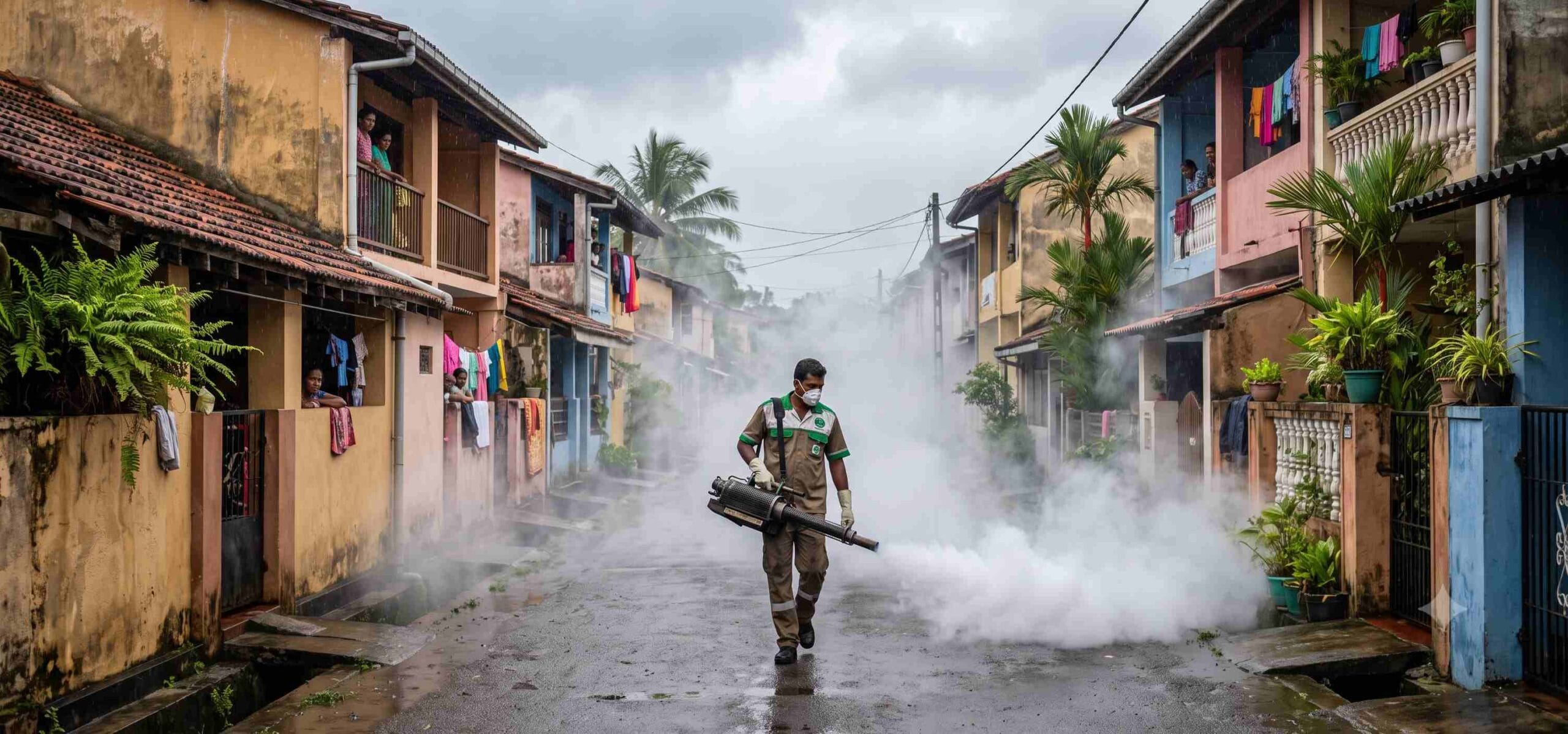
Sri Lanka’s Dengue Epidemic Crosses 67,000 Cases — What It Means for India This Monsoon
Sri Lanka is in the grip of one of its most serious dengue outbreaks in recent years. As of mid-July 2026, the island nation has recorded 67,143 confirmed dengue cases and 47 deaths since the start of the year, with health authorities confirming the outbreak has escalated to full epidemic status. Perhaps most alarming is the pace of spread: the country reported 7,038 new cases in just the first six days of July alone, pushing the daily average of new infections past 1,000 cases a day — a sharp jump from the 600–700 daily cases being recorded when the epidemic was first officially declared in June.
For India, separated from Sri Lanka by little more than the narrow Palk Strait, this isn’t a distant headline. Dengue is a shared regional threat across South Asia, driven by the same mosquito species, the same monsoon rainfall patterns, and increasingly, the same climate pressures. Understanding what’s happening in Sri Lanka offers a preview of the risks India’s own health system needs to be watching closely.
How Sri Lanka’s Outbreak Escalated
Sri Lanka’s National Dengue Control Unit (NDCU) first flagged the crossing of 50,000 cases in late June, when officials described daily case additions in the range of 600 to 700. Within roughly two weeks, that pace had accelerated dramatically, with case numbers climbing past 63,000 by July 8 and touching 67,143 by July 11, alongside 47 confirmed deaths.
Health officials attribute the surge to a combination of factors: favourable weather conditions for mosquito breeding, widespread and persistent breeding sites across residential and public areas, and what officials have described as insufficient public participation in prevention efforts. The outbreak has coincided with Sri Lanka’s southwest monsoon, which brings the kind of intermittent rainfall and standing water that create ideal conditions for the Aedes aegypti mosquito — the primary vector responsible for transmitting the dengue virus — to breed.
In response, Sri Lankan authorities launched a special dengue control campaign covering 600 identified high-risk hotspot areas, focused on eliminating mosquito breeding sites through community clean-up drives and public awareness programmes involving schools, local authorities, and government agencies. The campaign uncovered thousands of active mosquito breeding sites during its nationwide sweep. Building on this, health officials have announced a further Enhanced Dengue Eradication Programme launching in 60 additional high-risk zones, coordinated through the Clean Sri Lanka programme under the Presidential Secretariat, signalling that authorities view the current trajectory as requiring an intensified, more targeted response.
Not Sri Lanka’s First Major Crisis
While the current numbers are severe, they remain below Sri Lanka’s historic worst outbreak. In 2017, the country recorded more than 186,000 dengue cases and 440 deaths in a single year — a scale that dwarfs the current epidemic even at its accelerated pace. Still, health officials are treating the present trajectory with urgency, given that case numbers are rising steeply rather than plateauing, and the monsoon season driving mosquito breeding is far from over.
Why This Matters for India
Dengue does not respect national borders, and South Asia’s shared climate and mosquito ecology mean outbreaks in one country often mirror — or foreshadow — trends elsewhere in the region. According to WHO’s South-East Asia Regional Office (SEARO), Sri Lanka, India, Bangladesh, Thailand, and Nepal have all been reporting dengue activity through 2026, with transmission patterns shaped by the same seasonal monsoon dynamics across the region.
India’s own dengue situation this year has drawn particular concern from public health experts, not because of case volume alone, but because of timing. According to the National Center for Vector Borne Diseases Control (NCVBDC), India recorded nearly 6,927 dengue cases by the end of February 2026 — a period that has historically seen very low transmission. Health experts note this early-year figure already exceeded the entire January–May dengue caseload recorded in 2021, and was approaching 2022 levels, despite covering only two months. Physicians across multiple Indian states have reported dengue cases appearing weeks before the monsoon officially arrived, a pattern experts describe as a meaningful shift from dengue’s traditional identity as a strictly monsoon and post-monsoon disease.
Public health specialists point to rising temperatures, erratic rainfall, and rapid urbanisation as key factors extending the mosquito breeding season and expanding dengue’s transmission window in India — echoing some of the same climate-linked pressures cited by Sri Lankan officials for their own outbreak. Research has also linked long-term exposure to fine particulate air pollution with higher dengue mortality across dengue-endemic countries, adding another layer of environmental risk relevant to India’s heavily polluted urban centres.
How Dengue Spreads and Why It’s Hard to Control
Dengue is transmitted through the bite of Aedes aegypti mosquitoes, which breed in even small amounts of stagnant water — flowerpots, discarded tyres, water storage containers, construction sites, and blocked drains are all common breeding grounds in both Sri Lankan and Indian cities. Unlike some vector-borne diseases with a narrow seasonal window, dengue’s transmission period is directly tied to temperature and rainfall patterns, which is precisely why warming climates and unpredictable monsoon rainfall are making outbreaks harder to predict and contain across the region.
Symptoms of dengue typically include sudden high fever, severe headache, pain behind the eyes, joint and muscle pain, rash, and in more severe cases, bleeding manifestations. Most cases are managed with supportive care, but a subset of patients can progress to severe dengue, involving plasma leakage, bleeding, and organ impairment, which requires prompt hospitalisation and can be fatal without timely treatment — a key reason rising case counts translate directly into greater strain on hospital systems.
Lessons India Can Draw From Sri Lanka’s Response
Sri Lanka’s intensified response offers a useful template for vector-control strategy that Indian states can draw on as the monsoon progresses:
- Hotspot-based targeting: Rather than spreading resources evenly, Sri Lanka concentrated intervention in identified high-risk zones, allowing for more intensive and efficient mosquito breeding site elimination.
- Community mobilisation: Clean-up drives involving schools, local government, and residents directly addressed the “insufficient public participation” that officials flagged as a driver of the outbreak — a reminder that dengue control depends heavily on household-level cooperation, not just government fogging drives.
- Real-time surveillance and escalation: Sri Lankan authorities moved quickly from a 23-zone intervention to a 60-zone Enhanced Dengue Eradication Programme within days, reflecting continuous monitoring and willingness to scale up rapidly as case trends worsened.
- Early awareness campaigns: Public messaging around eliminating standing water and recognising symptoms early was integrated into the response from the outset, rather than added only after cases peaked.
India’s own dengue surveillance runs through the NCVBDC and the Integrated Disease Surveillance Programme, with real-time reporting increasingly routed through the Integrated Health Information Platform (IHIP). Health officials in India have already issued advisories urging states to strengthen surveillance mechanisms and pre-position prevention and vector-control activities ahead of peak transmission, precisely the kind of proactive posture Sri Lanka’s escalating outbreak underscores the value of.
What Indian Households Can Do Now
With India’s own dengue transmission window widening and neighbouring Sri Lanka’s epidemic showing no signs of slowing, basic household-level precautions remain the most effective first line of defence:
- Eliminate standing water around homes — in flowerpots, coolers, discarded containers, and blocked drains — at least once a week
- Use mosquito repellents and nets, particularly during early morning and late afternoon hours when Aedes mosquitoes are most active
- Wear full-sleeved clothing in high-risk or heavily mosquito-populated areas
- Seek prompt medical attention for sudden high fever accompanied by headache, joint pain, or rash, rather than assuming it is a routine viral infection
- Support local vector-control efforts, including cooperating with municipal fogging and inspection drives
The Bigger Picture
Sri Lanka’s epidemic is a stark reminder that dengue remains one of the most persistent and rapidly escalating public health threats in South Asia, and that outbreaks can accelerate quickly even after officials believe they have a handle on transmission. With India’s own 2026 dengue season already showing signs of an earlier, less predictable pattern, the crisis unfolding in Sri Lanka is less a distant news story and more a regional early warning — one that reinforces the importance of sustained vector control, early diagnosis, and public cooperation well before the peak of the monsoon arrives.
Frequently Asked Questions
1. How many dengue cases has Sri Lanka reported in 2026? As of mid-July 2026, Sri Lanka has recorded 67,143 confirmed dengue cases and 47 deaths since the start of the year, with the daily average of new infections now exceeding 1,000 cases.
2. Why is Sri Lanka’s dengue outbreak accelerating so quickly? Health officials attribute the surge to favourable weather for mosquito breeding during the southwest monsoon, widespread breeding sites across the country, and insufficient public participation in prevention and clean-up efforts.
3. Is India also at risk of a dengue surge this year? Yes. India recorded nearly 6,927 dengue cases by the end of February 2026 alone — an unusually high count for that period — and physicians across several states have reported cases appearing weeks before the monsoon officially began, suggesting an expanding transmission window.
4. How does dengue spread, and why is it hard to control? Dengue spreads through the bite of Aedes aegypti mosquitoes, which breed in even small amounts of stagnant water. Because transmission is closely tied to temperature and rainfall, erratic monsoon patterns and rising temperatures make outbreaks increasingly difficult to predict and contain.
5. What can households do to protect themselves from dengue? Eliminate standing water around the home weekly, use mosquito repellents and nets during peak biting hours, wear full-sleeved clothing in high-risk areas, and seek prompt medical attention for sudden high fever with headache, joint pain, or rash.
References (Vancouver Style)
- Colombo Times. Enhanced dengue eradication programme from Monday, July 13 in 60 high-risk zones [Internet]. Colombo Times; 2026 Jul 11 [cited 2026 Jul 12]. Available from: https://colombotimes.net/enhanced-dengue-eradication-programme-from-monday-july-12-in-60-high-risk-zones/
- Lanka Newspapers. Sri Lanka’s dengue crisis deepens: over 67,000 cases and 47 deaths recorded [Internet]. Lanka Newspapers; 2026 Jul 11 [cited 2026 Jul 12]. Available from: https://www.lankanewspapers.com/2026/07/11/sri-lanka-s-dengue-crisis-deepens-over-67-000-cases-and-47-deaths-recorded
- Anadolu Agency. Sri Lanka’s dengue outbreak reaches epidemic level as cases top 50,000: health officials [Internet]. AA; 2026 Jun [cited 2026 Jul 12]. Available from: https://www.aa.com.tr/en/asia-pacific/sri-lanka-s-dengue-outbreak-reaches-epidemic-level-as-cases-top-50-000-health-officials/3979458
- Al Jazeera. Why India’s deadly dengue crisis is now no longer confined to the monsoons [Internet]. Al Jazeera; 2026 Jun 11 [cited 2026 Jul 12]. Available from: https://www.aljazeera.com/news/2026/6/11/why-indias-deadly-dengue-crisis-is-now-no-longer-confined-to-the-monsoons
- National Center for Vector Borne Diseases Control. Dengue situation in India [Internet]. New Delhi: Ministry of Health and Family Welfare, Government of India; [cited 2026 Jul 12]. Available from: https://ncvbdc.mohfw.gov.in/index4.php?lang=1&level=0&linkid=431&lid=3715