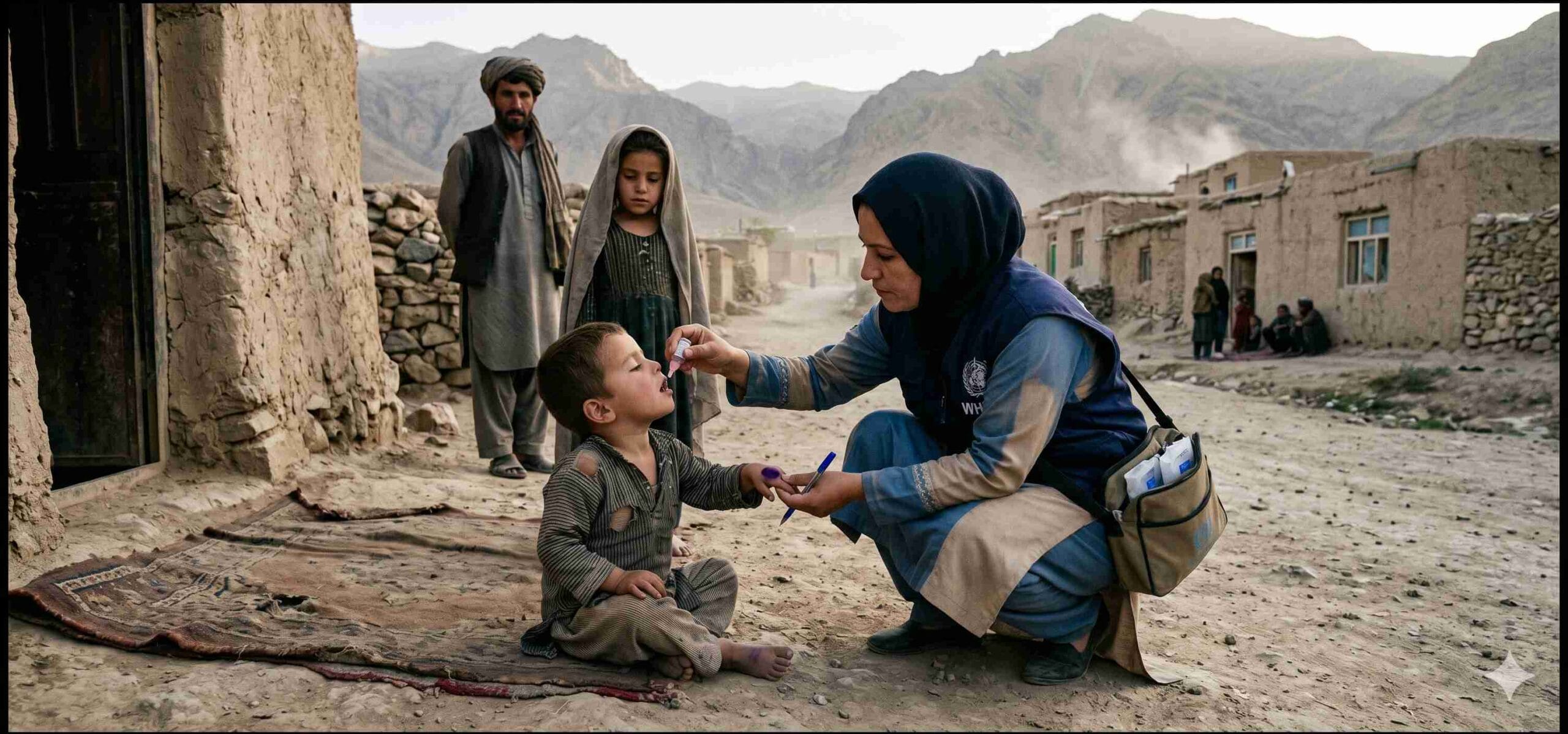
In the Nari district of Kunar province — a mountainous, conflict-affected region in eastern Afghanistan — a child’s legs stopped working. In Nahr-e-Siraj district of Helmand province in the country’s south, another child suffered the same fate. Both cases were confirmed as wild poliovirus type 1 (WPV1). Both added to what is now a total of six confirmed WPV1 cases in Afghanistan in 2026 — making this country, once again, one of only two places on Earth where this ancient, devastating, and entirely vaccine-preventable disease continues to paralyse children.
The number six does not sound large in the context of global disease. But in the context of the world’s longest-running public health campaign — the Global Polio Eradication Initiative, which has reduced polio cases by more than 99.9% since 1988 — every confirmed WPV1 case is a warning, a failure, and a call to action. The world has been trying to eradicate polio for decades. Afghanistan, alongside Pakistan, is the reason it has not yet succeeded.
Understanding Wild Poliovirus Type 1: What Makes It So Dangerous
Poliomyelitis — polio — is caused by the poliovirus, an RNA virus that enters the body through the mouth, typically through contaminated water or food, and multiplies in the intestines. In most infected individuals, the illness is mild or entirely without symptoms. But in approximately one in every 200 infections, the virus invades the nervous system and causes irreversible flaccid paralysis — most often in the legs. There is no cure. Once paralysis occurs, it is permanent.
There are three strains of wild poliovirus: types 1, 2, and 3. Type 2 was certified eradicated in 2015; type 3 in 2019. Only Wild Poliovirus Type 1 (WPV1) remains in circulation. Every single case of paralytic polio caused by wild virus anywhere in the world today is a WPV1 case — and every one of those cases originates in Afghanistan or Pakistan, the planet’s last two endemic countries.
WPV1 is highly infectious. In areas with low vaccination coverage, it spreads efficiently, primarily through faecal-oral transmission — exacerbated by inadequate water, sanitation and hygiene (WASH) infrastructure. Critically, for every child who develops visible paralysis, an estimated 200 to 1,000 others are silently infected and capable of spreading the virus further. Environmental surveillance — testing sewage and water samples for viral presence — consistently reveals the virus circulating far more widely than clinical cases alone suggest.
In 2026, Afghanistan’s six clinical cases are accompanied by environmental detections that paint a broader picture of ongoing transmission. The most recent WPV1-positive environmental sample from the country was collected on April 27, 2026.
The 2026 Situation: Where Afghanistan Stands
The six confirmed WPV1 cases in Afghanistan in 2026 represent cases with paralysis onset from Kunar and Helmand provinces — two of the most operationally challenging areas for the polio programme. The most recent case had an onset of paralysis on May 7, 2026.
This comes after 21 total WPV1 cases in Afghanistan and Pakistan combined in 2025, which was itself a steep decline from 62 cases across both countries in 2024 — a year that saw a 283% increase in paralytic cases in Afghanistan and a 550% increase in Pakistan compared to 2023. The trajectory in 2025 was encouraging; the persistence of cases in 2026, despite major vaccination drives, underscores just how difficult the final push toward eradication truly is.
In April 2026, Afghanistan and Pakistan conducted a landmark synchronized vaccination campaign — a coordinated national push across both countries simultaneously. From April 13 to 19, 2026, Pakistan reached 44.8 million children; Afghanistan simultaneously reached 12.8 million children under five in its first nationwide campaign of the year, with Vitamin A co-administered to children aged 6–59 months. The synchronisation reflects a core epidemiological reality: Afghanistan and Pakistan form a single epidemiological bloc. Poliovirus does not recognise the Durand Line.
Despite this campaign — and despite the significant political and operational investment behind it — new cases continued to be confirmed. This is not a failure of the vaccine. The oral polio vaccine is extraordinarily effective. It is a failure of reach: the persistent inability to vaccinate every child, every time, in regions defined by insecurity, displacement, and distrust.
Why Afghanistan Cannot Get to Zero: The Structural Barriers
To understand why Afghanistan remains a WPV1 reservoir in 2026, it is essential to understand the specific, layered challenges that make vaccination — one of medicine’s simplest and most powerful interventions — so difficult to deliver.
Insecurity and inaccessibility: Southern Afghanistan — particularly Helmand — and parts of the eastern region including Kunar and Nangarhar have historically been among the most inaccessible areas for vaccination teams. The Taliban authorities have, since late 2021, permitted nationwide polio campaigns to resume, but site-to-site vaccination approaches — in which vaccinators operate from fixed posts rather than going house-to-house — leave significant gaps in coverage. The WHO’s Emergency Committee has repeatedly urged the Afghanistan programme to explore transitioning to house-to-house vaccination, noting that site-to-site campaigns have not achieved the coverage quality required for eradication.
Population displacement and cross-border movement: The ongoing return of large numbers of undocumented migrants from Pakistan to Afghanistan — a movement that accelerated following Pakistan’s expulsion of undocumented Afghans — creates a dynamic, constantly shifting population that is extraordinarily difficult to track and vaccinate. Children among returned migrant families may have received no or incomplete vaccination. At border crossing points, vaccination is offered, but it cannot be made compulsory, and many families pass through without accessing services.
Immunity gaps from past inaccessibility: During periods of active conflict — particularly between 2018 and 2021 — large swathes of southern and eastern Afghanistan were entirely inaccessible to vaccination teams. An entire birth cohort of children was born, grew, and remained unvaccinated during these years. These are precisely the children who are most vulnerable today, and who represent the immune gap through which WPV1 continues to circulate.
The YB3A genetic cluster: Genomic surveillance of WPV1 isolates in Afghanistan has confirmed that the dominant circulating strain — the YB3A cluster — has split into two sub-lineages, a marker that indicates a large population of under-immunised children in whom the virus is evolving. This genetic diversification signals ongoing, sustained transmission rather than isolated spillover events.
The Global Stakes: Why Afghanistan’s Six Cases Matter to the World
Poliovirus does not require a passport. As long as WPV1 continues to circulate in Afghanistan — even at low levels — it poses a risk to any unvaccinated or under-vaccinated individual anywhere in the world. This is not theoretical. Environmental surveillance has detected WPV1 poliovirus in several countries — including, strikingly, environmental samples in parts of Europe — linked to travel and population movement from endemic regions.
The WHO has maintained its classification of the poliovirus situation as a Public Health Emergency of International Concern (PHEIC) continuously since May 2014 — now over twelve years. The 44th meeting of the IHR Emergency Committee, convened in January 2026 and reporting in March 2026, confirmed that this PHEIC designation continues. Countries at risk of importation are required under the IHR Temporary Recommendations to ensure that residents and long-term visitors have received a documented dose of inactivated poliovirus vaccine (IPV) or oral polio vaccine (OPV) before departure.
The GPEI’s revised strategy timeline aims for interruption of WPV1 transmission by end-2027 and formal certification of eradication thereafter. Whether this target holds depends almost entirely on what happens in southern Afghanistan and the Pakistan-Afghanistan border regions in the next 18 months.
Pakistan’s Role: One Epidemiological Bloc, One Shared Challenge
While this article focuses on Afghanistan’s six cases, Pakistan’s situation is inseparable. Pakistan has confirmed three WPV1 cases in 2026 as of the same reporting period, with environmental detections ongoing in Khyber Pakhtunkhwa, Karachi, and beyond. Pakistan’s WPV1 transmission has historically been more geographically widespread than Afghanistan’s, with the Karachi metropolitan area serving as an amplification hub due to its large, mobile population of Afghan origin.
The April 2026 synchronized campaign — Pakistan’s second nationwide polio campaign of 2026, reaching 44.8 million children — represents exactly the kind of coordinated, border-agnostic approach that eradication demands. Both countries maintain cross-border mechanisms, vaccination at transit points, and shared epidemiological data systems. Yet the persistence of WPV1 in both countries despite decades of campaigning is a reminder that technical solutions, however well-designed, cannot compensate for political instability, displacement, and the chronic under-resourcing of health system infrastructure in conflict zones.
Funding Fragility: A Global Programme at Risk
No less important than the operational challenges is the financial threat facing the eradication effort. The Global Polio Eradication Initiative — the largest internationally coordinated public health programme in history — is financed primarily through donor contributions. In a global environment of tightening aid budgets and shifting geopolitical priorities, that funding base is under unprecedented pressure. Health Policy Watch has flagged that funding gaps and supply chain disruptions could rapidly reverse years of hard-won gains.
An estimated US$4.8 billion is required for GPEI implementation through 2028. Even partial shortfalls translate directly into fewer vaccination campaigns, weaker surveillance, and — inevitably — more children paralysed by a virus that a few drops of vaccine can prevent.
What Still Needs to Happen: The Final Push
The path to zero WPV1 cases is clear, even if it is not easy. The GPEI’s 2026 Action Plan prioritises the low-transmission season — which runs approximately from November through April — as the critical window to interrupt remaining transmission chains. Success requires:
- Transition to house-to-house vaccination in southern Afghanistan, replacing site-to-site approaches that consistently miss high-risk children in insecure areas.
- Strengthened cross-border mechanisms between Afghanistan and Pakistan, including improved vaccination coverage for returning migrant populations.
- Sustained, high-quality campaigns — not just high reported coverage, but independently verified quality, targeting the specific districts and sub-districts where WPV1 is still circulating.
- Maintained and increased donor financing sufficient to support uninterrupted campaign implementation and environmental surveillance through the eradication endgame.
- Community engagement and trust-building in areas where vaccine hesitancy and historical distrust of health workers persist.
The world eradicated smallpox. It eliminated WPV2 and WPV3. WPV1 eradication is not a scientific challenge — the tools exist. It is a logistical, political, and humanitarian one. The six children paralysed in Afghanistan in 2026 are a reminder of what is at stake — and of the moral imperative to see this effort through to its conclusion.
Key Takeaways
- Afghanistan confirmed six WPV1 cases in 2026 as of late May, with cases from Kunar and Helmand provinces.
- WPV1 is the last remaining strain of wild poliovirus; types 2 and 3 have already been eradicated.
- Afghanistan and Pakistan form a single epidemiological bloc and are the world’s only two WPV1-endemic countries.
- For every case of paralysis, an estimated 200–1,000 children are silently infected and spreading the virus.
- A synchronized April 2026 campaign vaccinated over 57 million children across both countries simultaneously.
- WPV1 remains a PHEIC — the WHO Emergency Committee extended Temporary Recommendations in March 2026.
- The target for WPV1 eradication certification is 2027; meeting it depends on the next 18 months of high-quality campaigning.
Frequently Asked Questions (FAQs)
Q1. What is Wild Poliovirus Type 1 (WPV1), and how is it different from other types of polio? Wild Poliovirus Type 1 is the last surviving strain of naturally occurring poliovirus. Of the three original wild poliovirus strains, type 2 was declared eradicated in 2015 and type 3 in 2019. All current wild poliovirus cases globally are caused by WPV1. It spreads primarily through the faecal-oral route — through contaminated water and food — and causes permanent flaccid paralysis in approximately one in 200 infections. There is no treatment; only vaccination can prevent it.
Q2. Why has Afghanistan been unable to eradicate polio despite decades of vaccination campaigns? Eradication in Afghanistan is prevented by a convergence of structural barriers: armed conflict and active insecurity that prevents vaccination teams from reaching children in high-risk areas; site-to-site vaccination approaches that miss children in remote households; large-scale population displacement and cross-border movement between Afghanistan and Pakistan; cumulative immunity gaps in children born during periods of inaccessibility; and persistent vaccine hesitancy in some communities. Afghanistan and Pakistan together form a single epidemiological bloc where transmission on one side of the border sustains the virus on the other.
Q3. Is there a risk that polio from Afghanistan could spread to other countries, including India? Yes, this risk is real and is the reason polio remains a Public Health Emergency of International Concern since 2014. As long as WPV1 circulates in any country, unvaccinated individuals anywhere in the world are at risk through international travel and population movement. India, which was certified polio-free in 2014, maintains high routine immunisation coverage and strong surveillance precisely to guard against importation. Travellers to or from polio-affected regions are advised to ensure they are fully vaccinated, and IHR Temporary Recommendations require documented vaccination for residents and long-term visitors departing Afghanistan and Pakistan.
Q4. What vaccines are used to fight WPV1, and are they effective? Two types of vaccine are deployed against polio: the Oral Polio Vaccine (OPV), which is administered as drops and is easy to deliver at scale in campaigns; and the Inactivated Polio Vaccine (IPV), which is injected and used primarily in routine immunisation schedules. Both are highly effective. The oral bivalent OPV targeting WPV1 and WPV3 is the primary campaign tool in Afghanistan and Pakistan. A single dose provides strong protection, but multiple doses are needed in areas with high infection pressure and poor sanitation. In February 2026, WHO prequalified an additional novel oral polio vaccine, further strengthening the outbreak response toolkit.
Q5. What is the Global Polio Eradication Initiative, and when does it expect to finish the job? The Global Polio Eradication Initiative (GPEI) is a partnership led by national governments, WHO, UNICEF, the US CDC, the Bill & Melinda Gates Foundation, and Rotary International. Founded in 1988, it has reduced WPV1 cases by more than 99.9% — from an estimated 350,000 cases annually to just nine globally in 2026 so far. The revised GPEI strategy timeline targets interruption of WPV1 transmission by end-2027 and formal certification of eradication thereafter. Achieving this depends on sustained high-quality vaccination campaigns in southern Afghanistan and Pakistan’s endemic zones, continued donor financing, and strong political commitment — particularly from the Taliban authorities in Afghanistan, whose cooperation in permitting nationwide campaigns has been essential since late 2021.
References
- Global Polio Eradication Initiative. Polio this week [Internet]. Geneva: GPEI; 2026 Jun [cited 2026 Jun 21]. Available from: https://polioeradication.org/about-polio/polio-this-week/
- Global Polio Eradication Initiative. Pakistan and Afghanistan unite to protect millions of children in synchronized polio campaigns [Internet]. Geneva: GPEI; 2026 May 4 [cited 2026 Jun 21]. Available from: https://polioeradication.org/news/pakistan-and-afghanistan-unite-to-protect-millions-of-children-in-synchronized-polio-campaigns/
- World Health Organization. Statement of the forty-fourth meeting of the Polio IHR Emergency Committee [Internet]. Geneva: WHO; 2026 Mar 4 [cited 2026 Jun 21]. Available from: https://www.who.int/news/item/04-03-2026-statement-of-the-forty-fourth-meeting-of-the-polio-ihr-emergency-committee
- Ariana News. Polio cases in Afghanistan rise to six in 2026 as two new cases confirmed [Internet]. Kabul: Ariana News; 2026 Jun [cited 2026 Jun 21]. Available from: https://www.ariananews.af/polio-cases-in-afghanistan-rise-to-six-in-2026-as-two-new-cases-confirmed/
- Health Policy Watch. Wild poliovirus transmission persists in Afghanistan and Pakistan [Internet]. Geneva: Health Policy Watch; 2026 Feb 5 [cited 2026 Jun 21]. Available from: https://healthpolicy-watch.news/wild-poliovirus-transmission-persists-in-afghanistan-and-pakistan/