When the World Health Organization received an urgent notification on May 2, 2026, about a cluster of severe respiratory illness aboard a cruise ship in the Atlantic Ocean, global public health alarms went off almost immediately. The culprit? Hantavirus — specifically the Andes virus strain, one of the deadliest members of a family of viruses transmitted primarily through rodents. Three passengers had already died. The world took notice.
While health officials have been quick to reassure the public that the risk of widespread transmission remains extremely low, the 2026 outbreak has put Hantavirus firmly back in the spotlight, raising important questions about what this virus actually is, how it spreads, what it does to the human body, and — crucially — how we can protect ourselves.
What Is Hantavirus?
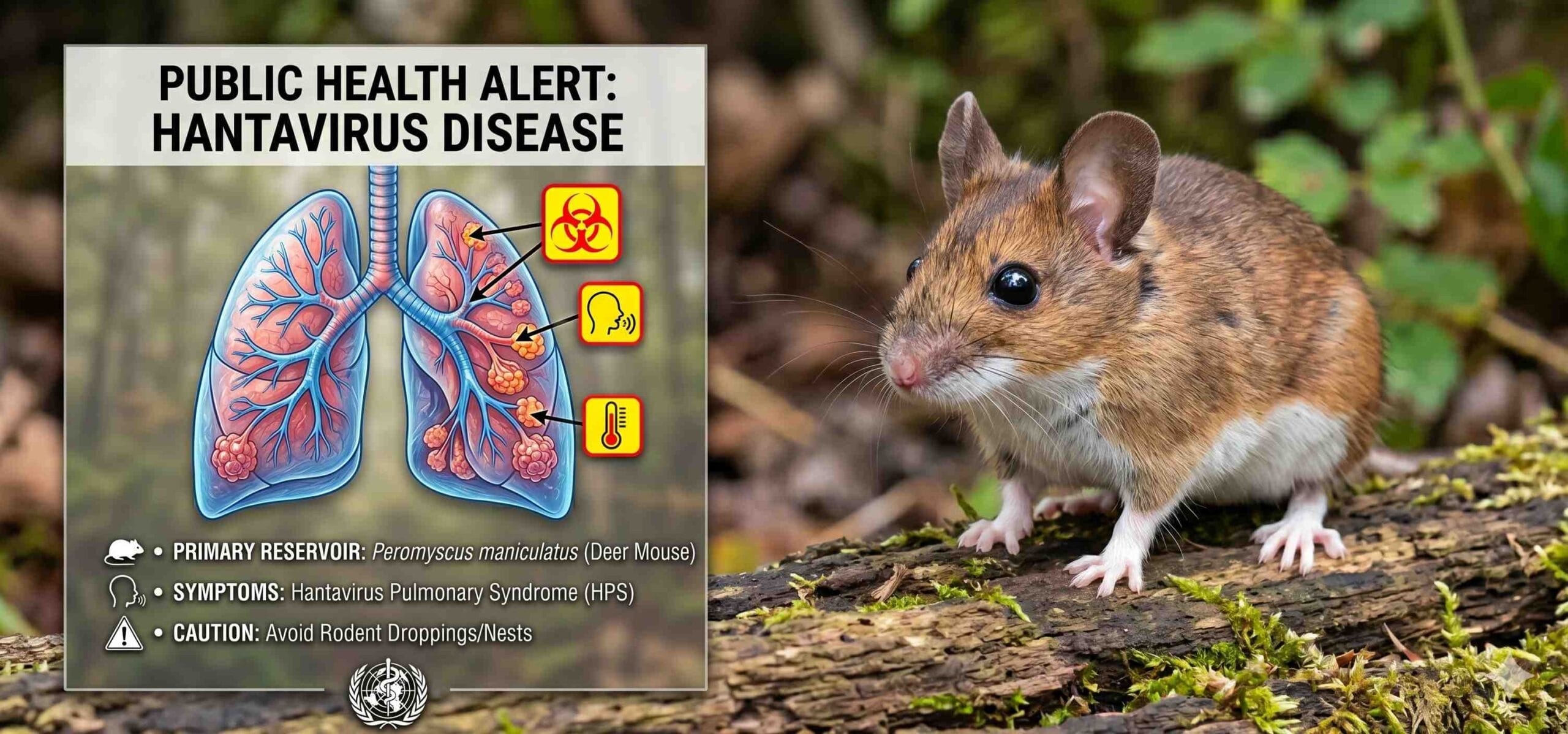
Hantavirus is not new. It is a group of RNA viruses belonging to the family Hantaviridae, and it has been known to cause serious illness in humans for decades. These viruses are carried primarily by small rodents — mice, rats, and voles — and can infect humans when they come into contact with the urine, droppings, or saliva of infected animals, or inhale dust contaminated with these materials.
There are two major disease syndromes caused by Hantavirus. The first is Hantavirus Pulmonary Syndrome (HPS), predominantly caused by New World hantaviruses found in the Americas — including the Andes virus and the Sin Nombre virus — and it primarily attacks the lungs. The second is Hemorrhagic Fever with Renal Syndrome (HFRS), caused by Old World hantaviruses found in Europe and Asia, which primarily affects the kidneys.
The 2026 outbreak involves the Andes virus, which causes HPS — a severe and potentially fatal lung disease. What makes Andes virus particularly concerning is a trait no other hantavirus shares: it is capable of limited human-to-human transmission.
The 2026 Outbreak: What Happened?
On April 1, 2026, the cruise ship MV Hondius — a Dutch-flagged vessel — departed from Ushuaia, Argentina, carrying 147 passengers and crew members from 23 countries. The ship travelled across the South Atlantic, making stops at some of the most remote locations on Earth: Antarctica, South Georgia Island, Tristan da Cunha, Saint Helena, and Ascension Island.
By the time the outbreak was officially reported to WHO on May 2, three passengers had already died. By May 20, a total of 11 cases had been confirmed or suspected across multiple countries, with no new cases or deaths reported in recent days. The ship docked in Rotterdam, the Netherlands, on May 18, where thorough sanitation procedures were immediately carried out.
Initial investigations suggest that the index case — the first person infected — likely acquired the Andes virus through environmental exposure in Argentina before boarding the ship. Given the documented epidemiological links between subsequent cases and the index patient, WHO and ECDC now believe there was subsequent human-to-human transmission aboard the vessel.
The identification of additional cases among passengers and crew who had already returned to their home countries — including Switzerland, France, and Spain — highlighted the long incubation period of Andes virus and the challenges of contact tracing in a globalised world.
Symptoms of Hantavirus Pulmonary Syndrome
One of the most dangerous aspects of Hantavirus Pulmonary Syndrome is how deceptively ordinary its early symptoms appear. In the initial phase, patients typically experience fever, fatigue, headache, and muscle aches — particularly in large muscle groups like the thighs, hips, back, and shoulders. Some patients also develop gastrointestinal symptoms such as nausea, vomiting, and abdominal pain.
Symptoms usually appear between one and eight weeks after exposure, though for Andes virus specifically, the incubation period can range from 4 to 42 days. This prolonged and variable incubation window makes outbreak control significantly more challenging.
The truly dangerous phase begins four to ten days after the initial symptoms. HPS progresses rapidly to what is known as the “cardiopulmonary phase”: the lungs begin to fill with fluid, breathing becomes difficult, and the patient may develop respiratory failure and shock. Without access to intensive care — including mechanical ventilation — the case fatality rate can be devastatingly high. In the 2026 outbreak, three of the 11 identified cases proved fatal.
Key symptoms to watch for include:
- Sudden high fever
- Severe muscle aches, especially in hips, thighs, and back
- Fatigue and general malaise
- Headache
- Nausea, vomiting, or diarrhoea
- Shortness of breath (a warning sign of progression)
- Coughing and chest tightness (late-stage)
Any person who has had potential rodent exposure — or, in the context of the 2026 outbreak, who travelled on MV Hondius — and develops these symptoms should seek medical attention immediately.
How Does Hantavirus Spread?
For the vast majority of hantavirus strains, transmission to humans occurs in one of three ways:
1. Inhalation: The most common route. When dried rodent urine or droppings are disturbed — during cleaning, camping, or working in rodent-infested environments — viral particles become airborne and can be inhaled.
2. Direct contact: Touching contaminated surfaces and then touching the eyes, nose, or mouth, or being bitten by an infected rodent.
3. Ingestion: Rarely, consuming food or water contaminated with rodent excretions.
The Andes virus adds a critical fourth pathway: person-to-person transmission. Unlike any other known hantavirus, Andes virus can spread between people through close, prolonged contact — including exposure to an infected person’s saliva, respiratory secretions, or other body fluids. This is believed to have occurred aboard MV Hondius, making the 2026 outbreak particularly significant from an epidemiological perspective. However, health authorities stress that this person-to-person transmission requires sustained close contact and is not efficient enough to cause widespread community spread.
Diagnosis: Why Early Detection Is Difficult
Diagnosing Hantavirus is notoriously challenging, particularly in the first 72 hours of symptoms, before the virus reaches detectable concentrations in body fluids. This difficulty contributed to the rapid deterioration of several patients in the 2026 outbreak before a diagnosis could be confirmed.
Laboratory tests used to diagnose HPS include PCR (polymerase chain reaction) assays and serological testing for hantavirus IgM and IgG antibodies. In the 2026 outbreak, confirmation came through a pan-hantavirus RT-PCR assay at the National Institute for Communicable Diseases (NICD) in South Africa, with subsequent sequencing confirming Andes virus.
Repeat testing is often required 72 hours after symptom onset to improve diagnostic accuracy. Clinicians are advised to maintain a high index of suspicion in patients with compatible symptoms and any history of rodent exposure or travel to South America.
Treatment: Supportive Care Is the Only Option
There is currently no licensed antiviral drug or vaccine for Hantavirus infection. Treatment is entirely supportive, focused on keeping the patient stable while the immune system fights the virus.
For severe HPS, this means hospitalisation — often in an intensive care unit — with mechanical ventilation to support breathing, careful fluid management to address pulmonary oedema, and haemodynamic monitoring. Early admission to the ICU dramatically improves outcomes; delayed care reduces the chance of survival significantly, because the cardiopulmonary phase can deteriorate with alarming speed.
The CDC has emphasised that patients with suspected HPS should not wait for a confirmed diagnosis before receiving supportive care. Time is critical.
Research into targeted treatments, including antiviral therapies such as ribavirin, continues, but as of May 2026, no specific treatment has received regulatory approval for general use.
Prevention: Practical Steps You Can Take
The good news is that Hantavirus is highly preventable with straightforward precautions. For most of the world, the risk remains linked almost entirely to rodent exposure rather than person-to-person transmission.
Reduce rodent exposure at home and outdoors:
- Seal gaps and holes in walls, roofs, and foundations to prevent rodents from entering your home.
- Store food — including pet food — in airtight, rodent-proof containers.
- Keep your home and surroundings clean, eliminating potential nesting sites such as woodpiles or debris near the house.
Safe cleaning of rodent-contaminated areas:
- Never vacuum or sweep dried rodent droppings — this aerosolises viral particles. Instead, wet surfaces with a disinfectant bleach solution (1 part bleach to 10 parts water) before carefully wiping up with gloves.
- Wear rubber or plastic gloves and a respiratory mask (N95 or better) when cleaning contaminated areas.
Outdoor precautions:
- When camping or hiking, avoid areas with visible rodent activity.
- Do not sleep on bare ground; use a tent with a floor or an elevated sleeping surface.
- Keep food stored securely and do not leave crumbs or waste that could attract rodents.
For the 2026 Andes virus context specifically:
- Travellers who were aboard MV Hondius or in close contact with confirmed cases should follow the monitoring guidance issued by their national health authorities.
- If symptoms develop, contact a healthcare provider immediately and disclose the exposure history.
Global Response and Public Health Risk Assessment
The response to the 2026 outbreak has been swift and coordinated. The CDC deployed a response team to meet the ship in the Canary Islands, repatriating 18 remaining passengers on May 10. WHO, ECDC, and multiple national public health agencies established monitoring protocols for potentially exposed individuals in over 23 countries.
Both the WHO and ECDC have assessed the risk to the general public as very low. The WHO’s chief of Epidemic and Pandemic Preparedness, Maria Van Kerkhove, captured the appropriate balance of concern and reassurance: “This is not the next COVID, but it is a serious infectious disease.”
The risk to the global public is low because Andes virus does not circulate in European, Asian, or North American rodent populations, and human-to-human transmission requires close, prolonged contact rather than casual interaction. Nevertheless, the outbreak serves as a powerful reminder of how quickly a zoonotic disease can cross borders in a world of international travel.
Key Takeaways
- Hantavirus is a rodent-borne virus causing two main syndromes: HPS (lung disease) and HFRS (kidney disease).
- The Andes virus — responsible for the 2026 cruise ship outbreak — is the only hantavirus capable of limited human-to-human transmission.
- As of May 20, 2026, 11 cases and 3 deaths have been reported across multiple countries linked to MV Hondius.
- Symptoms appear 1–8 weeks after exposure and progress rapidly; early ICU care is critical.
- No vaccine or specific antiviral treatment currently exists; supportive care is the only management strategy.
- Prevention hinges on avoiding rodent contact and safely cleaning contaminated environments.
- The global public health risk remains very low, but awareness and early clinical recognition are essential.
References
- World Health Organization. Hantavirus cluster linked to cruise ship travel, multi-country. Disease Outbreak News. 2026 [cited 2026 May 21]. Available from: https://www.who.int/emergencies/disease-outbreak-news/item/2026-DON599
- Centers for Disease Control and Prevention. Andes virus outbreak on a cruise ship: current situation. 2026 [cited 2026 May 21]. Available from: https://www.cdc.gov/hantavirus/situation-summary/index.html
- European Centre for Disease Prevention and Control. Andes hantavirus outbreak on a cruise ship, 20 May 2026. 2026 [cited 2026 May 21]. Available from: https://www.ecdc.europa.eu/en/infectious-disease-topics/hantavirus-infection/surveillance-and-updates/andes-hantavirus-outbreak
- Centers for Disease Control and Prevention. 2026 Multi-country hantavirus cluster linked to cruise ship. Health Alert Network Notice HAN-00528. 2026 [cited 2026 May 21]. Available from: https://www.cdc.gov/han/php/notices/han00528.html
- New England Journal of Medicine. Andes hantavirus outbreak on a cruise ship, 2026. N Engl J Med. 2026 [cited 2026 May 21]. Available from: https://www.nejm.org/doi/full/10.1056/NEJMc2606496