
Immunization & Vaccines: Why Every Shot Saves Lives
Immunization is widely regarded as one of the greatest achievements in the history of medicine. From eradicating smallpox to bringing polio to the brink of elimination, vaccines have fundamentally transformed the way humanity deals with infectious disease. Yet, despite decades of scientific progress, immunization programs continue to face challenges — from cold chain failures to vaccine hesitancy. Understanding the full picture of how vaccines work, how they are delivered, and why public trust matters is essential for anyone involved in public health, healthcare delivery, or community awareness.
What Is Immunization and Why Does It Matter?
Immunization is the process by which an individual is made resistant to an infectious disease, typically through the administration of a vaccine. Vaccines work by training the immune system to recognise and fight specific pathogens — whether viruses or bacteria — without causing the actual disease. When a sufficient proportion of a population is immunised, a phenomenon known as herd immunity (or community immunity) kicks in, protecting even those who cannot be vaccinated, such as newborns or immunocompromised individuals.
The global impact of vaccines is staggering. According to the World Health Organization (WHO), immunization currently prevents between 3.5 and 5 million deaths every year from diseases such as diphtheria, tetanus, pertussis, influenza, and measles. Diseases that once killed or disabled millions — such as polio and smallpox — have been dramatically reduced or entirely eliminated through coordinated vaccination campaigns.
The importance of immunization extends beyond the individual. Strong national immunization programs protect healthcare systems from being overwhelmed by preventable disease outbreaks, reduce antimicrobial resistance (since fewer infections mean less antibiotic use), and contribute to broader economic productivity by keeping populations healthy and active.
Key Vaccines and the Diseases They Prevent
Modern immunization schedules cover a broad range of infectious diseases across the life course. Some of the most critical vaccines include:
- Measles, Mumps, and Rubella (MMR): Measles alone killed over 140,000 people globally in 2018, mostly children under five. The MMR vaccine is one of the most effective immunological tools ever developed.
- Oral Polio Vaccine (OPV) / Inactivated Polio Vaccine (IPV): Polio once paralysed hundreds of thousands of children annually. Today, thanks to the Global Polio Eradication Initiative, wild poliovirus transmission has been interrupted in most of the world.
- DTP (Diphtheria, Tetanus, Pertussis): This combination vaccine protects against three life-threatening bacterial infections, particularly dangerous in infants.
- Hepatitis B: Universal infant vaccination against hepatitis B has significantly reduced the global burden of liver disease and liver cancer.
- COVID-19 Vaccines: The rapid development and global rollout of COVID-19 vaccines demonstrated the power of modern vaccinology and the critical role of international cooperation in pandemic response.
Each of these vaccines represents decades of scientific research and public health investment, making routine immunization one of the most cost-effective healthcare interventions available.
Cold Chain Management: The Invisible Backbone of Immunization
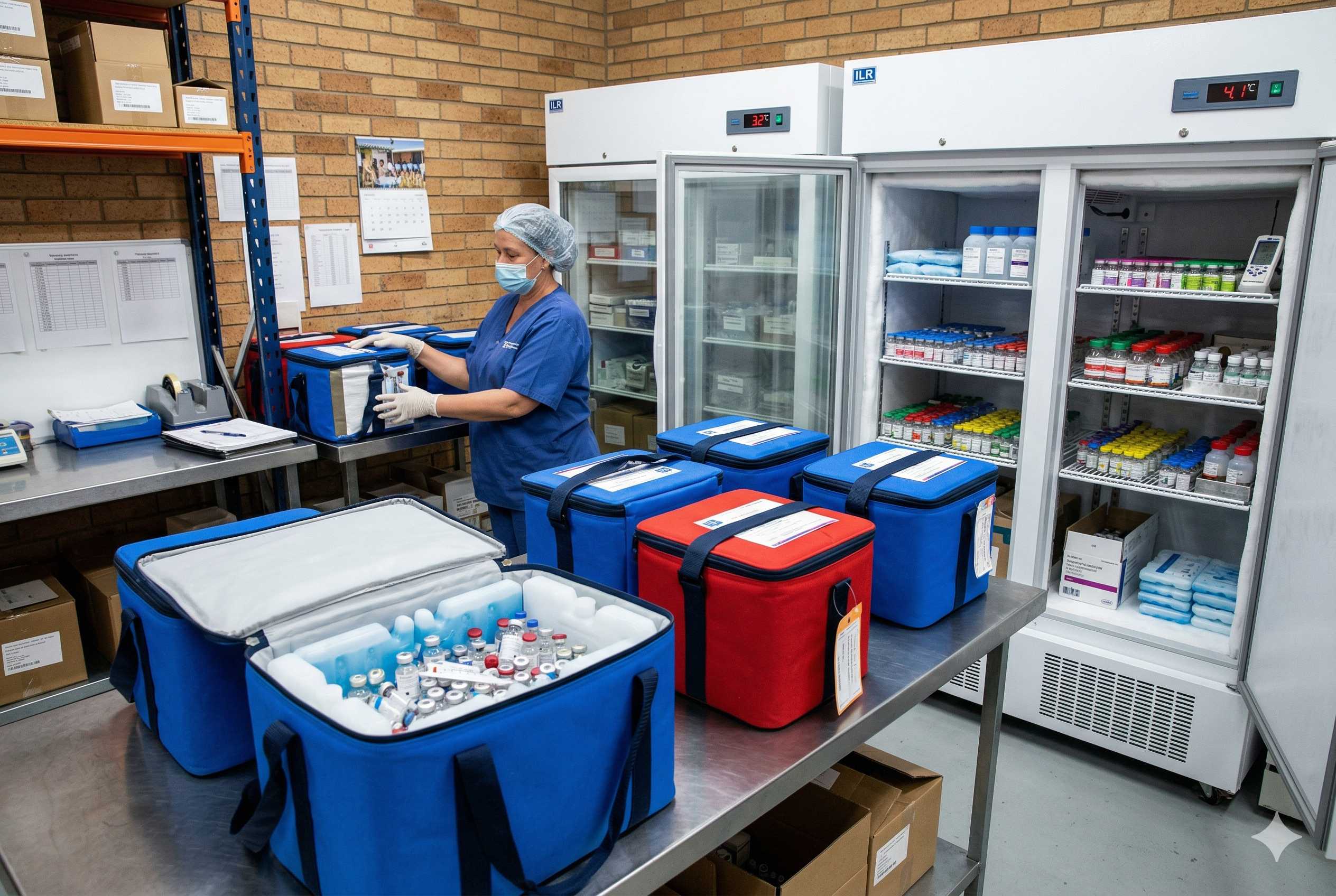
One of the most technically demanding aspects of any immunization program is the cold chain — the system of refrigerated storage and transport that keeps vaccines at the correct temperature from the point of manufacture to the point of administration. Most vaccines are highly sensitive to temperature fluctuations; exposure to excessive heat or freezing can render them ineffective or even harmful.
Maintaining an unbroken cold chain is critical in both high-income and low-resource settings. In remote or rural regions, this can be especially challenging. Vaccines may need to travel thousands of kilometres across variable climates before reaching a community health worker’s hands. Any break in the cold chain can result in entire batches of vaccines being silently inactivated — meaning children receive injections that offer no protection.
Effective cold chain management involves several key components:
- Vaccine refrigerators and freezers at health facilities and district stores that maintain temperatures between +2°C and +8°C (or colder for certain vaccines like varicella)
- Cold boxes and vaccine carriers for transporting vaccines during outreach or field campaigns
- Temperature monitoring devices, including data loggers and vaccine vial monitors (VVMs), which provide real-time and cumulative temperature exposure data
- Trained logistics personnel who understand proper storage protocols, stock rotation (first-expiry-first-out), and emergency procedures for equipment failure
Modern innovations such as solar-powered refrigerators, passive cold chain equipment, and digital supply chain tracking systems have significantly improved cold chain reliability in resource-limited settings. However, significant gaps remain, and cold chain failure continues to be a leading cause of vaccine wastage globally.
Vaccine Confidence: The Social Side of Immunization
A vaccine sitting on a shelf, no matter how perfectly stored, saves no lives. Immunization programs ultimately depend on people accepting and seeking out vaccination — and this is where vaccine confidence becomes a defining challenge.
Vaccine hesitancy — the reluctance or refusal to vaccinate despite the availability of vaccines — has been identified by the WHO as one of the ten greatest threats to global health. The causes of hesitancy are complex and context-dependent, ranging from religious or cultural beliefs and distrust of healthcare systems, to misinformation spread through social media and historical abuses in medical research.
Why Vaccination Myths Persist
Despite overwhelming scientific evidence supporting vaccine safety and efficacy, myths and misinformation continue to circulate widely. Some of the most persistent myths include:
- The claim that vaccines cause autism (thoroughly debunked since the fraudulent 1998 Wakefield study was retracted)
- Beliefs that “natural immunity” is always superior to vaccine-induced immunity
- Concerns that multiple vaccines given together can “overload” the immune system
- Conspiracy theories suggesting vaccines contain harmful microchips or toxins
These myths persist for several reasons. Confirmation bias leads individuals to seek out and trust information that confirms their pre-existing beliefs. Social media algorithms amplify emotional and fear-based content. And when vaccine-preventable diseases become rare, the perceived risk of the disease diminishes while the perceived risk of the vaccine — however exaggerated — can feel more immediate.
How to Build and Sustain Vaccine Confidence
Addressing vaccine hesitancy requires more than just providing facts. Effective strategies include:
- Motivational interviewing by healthcare providers — non-confrontational conversations that acknowledge concerns without dismissing them
- Community engagement, involving trusted local leaders, religious figures, and peer educators as vaccine advocates
- Transparent communication about vaccine ingredients, clinical trial data, and potential side effects
- Rapid response to misinformation, with clear, accessible, jargon-free corrections distributed through trusted channels
Building vaccine confidence is not a one-time effort; it requires sustained investment in public health communication and community trust.
Public Health Immunization Systems: A Coordinated Effort
Successful immunization at the population level is never the work of a single actor. It depends on tightly coordinated public health systems that span national governments, international organisations, local health authorities, and frontline healthcare workers.
Key components of a functioning immunization system include:
Surveillance and Monitoring: Robust disease surveillance systems track vaccine-preventable disease incidence, identify outbreaks early, and measure vaccine coverage at the district and national level. Coverage surveys and administrative data help planners identify under-vaccinated populations.
Trained Healthcare Workers: Vaccinators, community health workers, nurses, and cold chain technicians are the backbone of immunization delivery. Their training must cover not only the technical aspects of vaccine administration but also communication skills, adverse event management, and anaphylaxis response.
Supply Chain and Logistics: Beyond cold chain storage, immunization logistics encompasses procurement, forecasting, stock management, and distribution to the last mile. Stockouts and over-supply are both costly problems that effective supply chain management aims to prevent.
Financing and Policy: Immunization programs are funded through a combination of national government budgets and international support from organisations such as Gavi, the Vaccine Alliance, and UNICEF. Strong national immunization policies, including legislation mandating vaccines for school entry where appropriate, provide the legal and administrative framework for high coverage.
Monitoring Frameworks: WHO and UNICEF jointly collect global immunization data through the WHO/UNICEF Estimates of National Immunization Coverage (WUENIC). These data inform program planning, resource allocation, and global health strategy.
The Road Ahead for Global Immunization
The COVID-19 pandemic exposed significant vulnerabilities in global immunization systems. Routine immunization coverage dropped sharply in 2020 and 2021 as health systems were overwhelmed and communities locked down. The result was a surge in measles and other vaccine-preventable disease outbreaks that continued to reverberate for years afterward.
Recovering and surpassing pre-pandemic coverage levels requires deliberate investment — in health system strengthening, community outreach to catch up missed children, and renewed political commitment to immunization as a global priority. The Immunization Agenda 2030 (IA2030), endorsed by the World Health Assembly, sets out an ambitious vision: a world where everyone, everywhere, at every age, benefits fully from vaccines.
Achieving that vision will require confronting the persistent challenges of cold chain reliability, vaccine hesitancy, health system fragility, and inequitable access — but the tools, evidence, and global will to do so have never been stronger.
Conclusion
Immunization is far more than a medical procedure — it is a public health system, a community endeavour, and a statement of collective responsibility. Every vaccine administered on time, stored correctly, and accepted willingly is a step toward a world with fewer preventable deaths, fewer outbreaks, and stronger, more resilient communities. Understanding the science, the logistics, and the social dimensions of immunization is essential for building the public health capacity the world needs.
References
- World Health Organization. Immunization coverage [Internet]. Geneva: WHO; 2023 [cited 2025 May 7]. Available from: https://www.who.int/news-room/fact-sheets/detail/immunization-coverage
- Centers for Disease Control and Prevention. Vaccines and immunizations [Internet]. Atlanta: CDC; 2024 [cited 2025 May 7]. Available from: https://www.cdc.gov/vaccines/index.html
- UNICEF. Cold chain equipment [Internet]. New York: UNICEF Supply Division; 2023 [cited 2025 May 7]. Available from: https://www.unicef.org/supply/cold-chain-equipment
- MacDonald NE; SAGE Working Group on Vaccine Hesitancy. Vaccine hesitancy: Definition, scope and determinants. Vaccine [Internet]. 2015 Aug 14 [cited 2025 May 7];33(34):4161–4. Available from: https://doi.org/10.1016/j.vaccine.2015.04.036
- World Health Organization. Immunization Agenda 2030: A global strategy to leave no one behind [Internet]. Geneva: WHO; 2020 [cited 2025 May 7]. Available from: https://www.who.int/immunization/immunization_agenda_2030/en/
Bundibugyo Ebola Outbreak 2026: How a Forgotten Virus Exposes the Global Health Equity Crisis
- Source: MResPilot